Best Backend as a Service (BaaS) Providers in 2026: Top Platforms Compared
Last reviewed November 2025 with 2026 pricing/features.
This comprehensive backend as a service (BaaS) platform comparison reviews the best BaaS providers and leading cloud backend platforms in 2026.
It meticulously compares key features of the top vendors, including database models, hosting flexibility, AI support, pricing approaches, and best-fit use cases to help development teams choose the right managed backend. The goal is to determine which platform truly offers the best backend as a service for your specific project.
The guide covers modern managed backend services, serverless backend platform features, and no-code/low-code backends used for mobile and web applications, ensuring you find the right backend as a service provider whether you are building a fast MVP or a high-scale enterprise application.
Contents
- 1 Key Takeaways
- 2 What Is a BaaS?
- 3 How to choose a Backend as a Service platform?
- 4 Top BaaS Providers in 2026
- 5 Back4app
- 6 Firebase
- 7 Parse
- 8 Backendless
- 9 NHost
- 10 AWS Amplify
- 11 Appwrite
- 12 Kuzzle
- 13 Supabase
- 14 PlayFab
- 15 8Base
- 16 Kii
- 17 PocketBase
- 18 Xano
- 19 Directus
- 20 Convex
- 21 CloudKit
- 22 Backend as a Service Comparison
- 23 Which is the Best Backend as a Service (BaaS) Platform for You?
- 23.1 Best BaaS for Startups (Free/MVP)- Top picks: Back4app, Firebase, Supabase.
- 23.2 Best BaaS for Enterprise/Compliance – Top picks: Back4app, AWS Amplify, Kii.
- 23.3 Best BaaS for Open-Source/Self-Hosting – Top picks: Parse, Directus, Appwrite.
- 23.4 Best BaaS for AI – Top picks: Back4app, Firebase, Xano.
- 24 Conclusion
- 25 FAQ
- 26 What is Backend as a Service (BaaS)?
- 27 What are the best backend as a service providers in 2026?
- 28 What is the difference between BaaS and serverless?
- 29 Which BaaS platform is best for startups?
- 30 Which is the most scalable backend as a service provider?
- 31 Which BaaS is best for AI applications?
Key Takeaways
Best backend as a service providers compared according to their features and pricing.
- Backend as a Service (BaaS) and Mobile backend as a service (MBaaS) options now deliver a ready-made backend covering database, auth, storage, and APIs, so teams avoid rebuilding common backend layers.
- A strong cloud backend platform provides backend infrastructure for apps with auto-scaling, monitoring, backups, and security built in—reducing operational work across MVPs and production apps.
- Providers differ most in data architecture: some are managed backend stacks centered on Postgres, others use NoSQL or embedded DBs, which affects performance, querying, and scalability.
- Many BaaS platforms combine a no-code / low-code backend experience with a serverless backend platformlayer (cloud functions, edge functions, background jobs) to support custom logic without DevOps.
- This backend platform comparison shows how each API backend platform aligns to a specific use case—startups shipping quickly, enterprises needing control/self-hosting, real-time apps, or AI-ready backends.
What Is a BaaS?
A Backend as a Service (BaaS) is a cloud-based model that provides developers with ready-to-use backend infrastructure and essential server-side features.
Instead of managing databases, setting up servers, handling authentication, or building APIs from scratch, development teams can rely on a BaaS platform to automate these tasks.
By using a backend as a service, businesses avoid the complexity of provisioning servers, ensuring redundancy, implementing security layers, and planning for scalability.
The platform handles these responsibilities automatically, allowing teams to focus on the frontend, user experience, and product development.
Typical capabilities offered by BaaS providers include:
- Managed databases (SQL, NoSQL)
- Auto-generated REST and GraphQL APIs
- Authentication and user management
- File storage and media handling
- Cloud functions or serverless logic
- Real-time data and notifications
- Hosting and deployment options
Overall, BaaS platforms streamline application development by removing the need to build and maintain backend infrastructure, enabling faster delivery and more efficient resource allocation.
How to choose a Backend as a Service platform?
Selecting a Backend as a Service (BaaS) platform depends on how well the provider matches the application’s architecture, growth stage, and operational constraints. A strong shortlist usually comes from comparing a few core decision areas:
- Database fit: Evaluate whether the platform offers a managed Postgres backend, a NoSQL backend, or an embedded/self-hosted option. Data model choice impacts query flexibility, real-time behavior, and long-term scale.
- Hosting model: Some solutions are fully managed cloud backend platforms, while others support self-hosting, BYOC, or on-prem deployments. Hosting flexibility matters for compliance, latency, and control.
- API capabilities: Prioritize platforms with auto-generated REST and/or GraphQL APIs and clean SDK support. The right API backend platform reduces boilerplate and speeds integration.
- Serverless and automation: Compare cloud functions, edge functions, background jobs, triggers, and workflow builders. A serverless backend platform is essential for custom logic without DevOps overhead.
- AI readiness: For AI-powered apps, check for vector storage, MCP/agent support, orchestration tools, and secure integration with LLMs.
A backend platform comparison using these layers typically reveals the most suitable provider for MVPs, production apps, or enterprise workloads.
Top BaaS Providers in 2026
Here’s a fast snapshot of the backend as a service providers covered in this guide. Each bullet gives the platform’s core positioning and what it’s typically used for.
- Back4app — Managed BaaS with real-time DB, auto REST/GraphQL APIs, cloud code, and scalable hosting.
- Firebase — Google BaaS with NoSQL databases, real-time sync, auth, cloud functions, and web hosting.
- Parse — Open-source BaaS framework for self-hosting or managed hosting, known for flexibility and control.
- Backendless — Low-code full-stack BaaS with visual logic, real-time data, auth, functions, and optional UI builder.
- Nhost — Open-source Postgres + Hasura GraphQL backend with auth, storage, functions, and realtime subscriptions.
- AWS Amplify — AWS-backed platform to spin up backends fast with auth, APIs, storage, hosting, and AWS integrations.
- Appwrite — Open-source backend with auth, database, storage, functions, realtime, and cloud or self-host options.
- Kuzzle — Open-source, IoT/data-first backend emphasizing realtime, modularity, and on-prem/cloud deployment.
- Supabase — Managed Postgres BaaS with instant APIs, realtime, auth/RLS, storage, edge functions, and AI-ready tools.
- PlayFab — Azure BaaS for games, covering player identity, LiveOps, analytics, and multiplayer services.
- 8Base — Serverless GraphQL BaaS that auto-generates CRUD APIs, realtime subscriptions, and custom functions.
- Kii — Enterprise IoT BaaS focused on device management, data control, and cloud/on-prem flexibility.
- PocketBase — Lightweight self-hosted BaaS with SQLite realtime DB, auth, storage, and admin UI.
- Xano — Visual no/low-code backend with managed Postgres, instant APIs, autoscaling, and native AI/agent + MCP support.
- Directus — Open-source layer turning any SQL DB into REST/GraphQL APIs, RBAC, automations, cloud or self-hosted.
- Convex — TypeScript-first realtime backend with reactive sync, server functions, scheduling, and managed or self-hosted use.
- CloudKit — Apple iCloud-native backend for Apple-ecosystem apps with managed data, offline sync, and sharing.
Back4app
Back4app is one of the most widely recognized Backend as a Service platforms, known for its developer-friendly environment, auto-generated APIs, and scalable cloud infrastructure.
Built on top of the open-source technologies, it offers a low-code backend that enables teams to build, host, and scale applications without managing servers or complex DevOps pipelines.
Today, Back4app is used by startups and enterprises to accelerate development, reduce infrastructure overhead, and streamline backend operations.
Core capabilities of Back4app include:
- AI-ready tools (MCP Server + Native Agents)
- Managed MongoDB database with real-time sync
- Auto-generated REST and GraphQL APIs
- Built-in authentication, RBAC, and security rules
- File storage with CDN delivery
- Cloud Code functions, background jobs, and webhooks
- Monitoring, backups, and automated scaling
- Low-code dashboard for data modeling and admin tasks
Features
Highly Scalable Infrastructure – Back4app provides a fully managed and scalable backend architecture. Applications can scale automatically as traffic grows, with flexible compute, storage, and database options.
Auto-Generated REST & GraphQL APIs – The platform automatically generates APIs from your data models, allowing developers to query and mutate data instantly using either REST or GraphQL.
Real-Time Database & Live Queries – Back4app includes real-time capabilities that allow applications to sync changes instantly.
User Authentication & Security – The platform provides robust built-in authentication, role-based access control (RBAC), session handling, and integration with OAuth providers. Data is encrypted at rest and in transit, and automated backups help ensure reliability and protection.
Cloud Code Functions – Cloud Code enables developers to run server-side logic without managing infrastructure. It supports scheduled jobs, background functions, webhooks, custom API endpoints, and integration with third-party services.
File Storage & CDN Delivery – Back4app manages file uploads, storage, resizing, and retrieval through a global CDN. It supports images, videos, documents, and other file types with configurable access rules.
Easy-to-Use Dashboard – The interface is clean, intuitive, and spreadsheet-like, making data modeling and database management simple. Developers can import/export data, create classes, and monitor logs with ease.
Pricing Summary
Back4app offers a transparent, predictable pricing model tailored to different development stages:
- Free Tier – Ideal for prototypes and small personal projects, with limited resources at no cost.
- MVP / Pay as you go Plans – Affordable option for early-stage applications, offering more storage, requests, and performance.
- Dedicated Plan – Fully isolated infrastructure with dedicated servers, high performance, SLAs, and custom resource allocation.
Pricing scales based on database size, request volume, file storage, data transfer, and additional compute. This flexibility allows teams to start small and scale predictably as their application grows.
Firebase
Firebase is a widely used Backend as a Service (BaaS) platform developed by Google.
It provides a fully managed backend for mobile and web applications, offering real-time capabilities, integrated analytics, and deep compatibility with the Google Cloud ecosystem.
Because of its ease of use and extensive documentation, Firebase is a preferred solution for startups and enterprises building scalable applications.
Core capabilities of Firebase include:
- Managed NoSQL databases (Firestore + Realtime Database)
- Real-time data sync and offline support
- Auto-integrated authentication providers
- Cloud Functions (serverless backend logic)
- Static/web hosting with global CDN
- File storage on Google Cloud Storage
- Push notifications via FCM
- Deep integration with Google Cloud and Analytics
Features
Realtime Database & Cloud Firestore – Firebase provides two NoSQL databases designed for different use cases. The Realtime Database enables instant synchronization across connected clients, which is ideal for chat apps, collaborative tools, or live dashboards. Cloud Firestore offers a more scalable and structured NoSQL model with advanced querying, offline support, hierarchical data organization, and strong consistency guarantees, making it suitable for modern, high-growth applications.
Authentication – Firebase Authentication simplifies user management by supporting multiple login methods, including email and password, social identity providers such as Google, Apple, GitHub, Facebook, and Twitter, as well as phone number authentication and anonymous login.
Cloud Functions – Cloud Functions for Firebase provide a serverless environment to run backend logic triggered by events.
Hosting – Firebase Hosting delivers fast, secure, and globally distributed hosting for web applications and static content.
Cloud Storage – Cloud Storage for Firebase is built on Google Cloud Storage infrastructure and provides secure file handling for photos, videos, and other media assets.
Cloud Messaging – Firebase Cloud Messaging (FCM) enables reliable delivery of push notifications across iOS, Android, and web applications without additional cost.
Pricing Summary
Firebase uses a two-tier pricing structure:
- Spark Plan (Free) – Ideal for prototypes and small apps.
- Blaze Plan (Pay-as-You-Go) – Apps that exceed free limits move to the Blaze tier, where billing is based on actual consumption.
Parse
Parse is one of the most established and widely adopted open-source Backend as a Service frameworks.
Originally created by Parse Inc. and later acquired by Facebook, the platform was open-sourced in 2016 and has since evolved into a robust ecosystem maintained by the developer community.
Parse enables developers to build modern, data-driven web, mobile, and IoT applications without managing server infrastructure manually.
As an open-source BaaS solution, Parse can be self-hosted or run through managed providers like Back4app, making it a flexible option for both startups and enterprise teams looking for transparency, extensibility, and control over their backend environment.
Core capabilities of Parse include:
- Open-source BaaS framework (self-host or managed)
- Auto-generated REST and GraphQL APIs
- Flexible schema and data modeling
- Built-in authentication and session handling
- Live Queries for real-time updates
- Cloud Code (server logic + jobs + triggers)
- File storage adapters + CDN options
- Push notification support (APNs/FCM)
Features
Auto-Generated REST & GraphQL APIs – Parse automatically generates APIs from your data models, allowing developers to interact with application data using REST or GraphQL without writing backend logic. This dramatically accelerates development and simplifies integration with any frontend framework.
Flexible Data Modeling – Developers can structure data using classes, fields, relations, pointers, and file types. The schema system is dynamic and easy to modify, making Parse suitable for fast iteration and applications with evolving requirements.
Authentication & User Management – Parse includes a built-in authentication system with session handling, password reset, email verification, RBAC roles, and OAuth/social login support when combined with custom adapters.
Real-Time Queries (Live Queries) – With Parse Live Queries, applications can subscribe to real-time updates for changes in the database. This is ideal for collaboration tools, dashboards, messaging apps, notifications, and interactive interfaces.
Cloud Code Functions – Parse allows developers to write server-side logic in JavaScript using Cloud Code. This includes triggers, scheduled jobs, custom APIs, and integrations with third-party services—without managing servers or containers.
File Storage – Developers can store a wide range of file types—images, videos, documents, and more—using Parse File storage. Files can be served through CDNs depending on the hosting provider.
Push Notifications – For mobile applications, Parse provides integrated support for APNs (iOS) and FCM (Android), enabling developers to send targeted push notifications through Cloud Code or dashboard tools.
Pricing Summary
Because Parse Server is open-source, teams can host it on AWS, Google Cloud, Azure, DigitalOcean, or any containerized environment—providing maximum control, compliance support, and cost flexibility.
Backendless
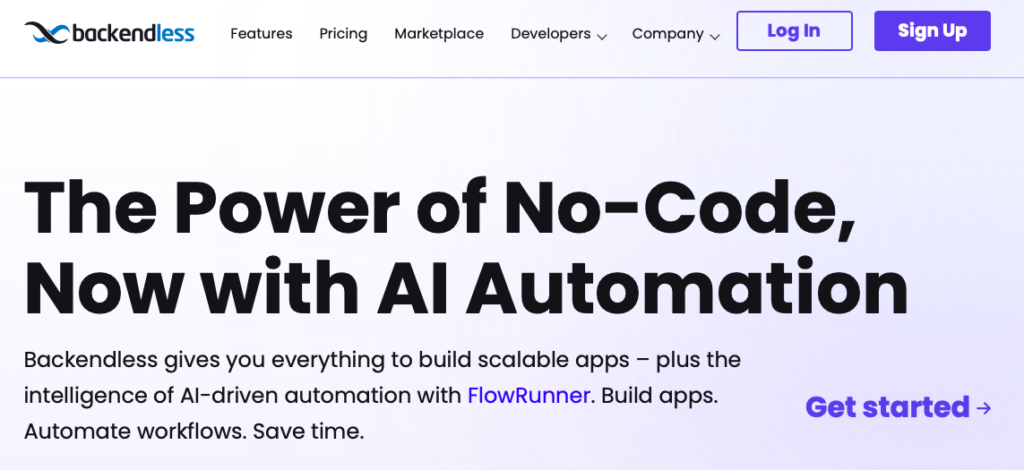
Backendless is a full-featured Backend as a Service (BaaS) and visual application development platform designed to streamline backend creation for web and mobile applications.
Founded in 2012, Backendless combines serverless capabilities, codeless logic, real-time databases, and UI-building tools in a single unified environment.
The platform is popular among teams that want tight integration between frontend and backend, especially for apps requiring real-time interactions or offline support.
Backendless can be used in the cloud, on-premises, or in a dedicated managed cluster, making it suitable for businesses with varying compliance, security, and scalability requirements.
Core capabilities of Backendless include:
- Managed backend with visual/no-code tools
- Real-time database and event subscriptions
- Built-in auth, user management, and RBAC
- Codeless logic builder + workflow automation
- Cloud Code (JavaScript/Java) for custom logic
- File storage with CDN delivery
- Push notifications + messaging
- UI Builder for full-stack low-code apps
Features
Codeless Logic & Visual Programming – Backendless offers a drag-and-drop visual logic builder that lets developers create business rules, workflows, API services, and background jobs without writing code. This is particularly useful for rapid development, prototypes, and no-code apps.
Real-Time Database – The platform provides a real-time database with automatic data sync between clients and the server. Developers can subscribe to events, track updates, and build interactive applications such as messaging, collaboration tools, and real-time dashboards.
User Authentication & Management – Backendless includes built-in user registration, login, session handling, roles, permissions, and integration with OAuth providers. The platform also supports email templates, password recovery workflows, and user directory management.
Cloud Code & Serverless Functions – For custom logic, Backendless supports JavaScript and Java Cloud Code. Developers can implement API event handlers, timers, custom endpoints, and third-party integrations without managing servers.
UI Builder – Unlike many BaaS platforms, Backendless includes a complete visual UI Builder that lets developers design frontend screens using templates and drag-and-drop components.
File Storage & CDN Delivery – The platform supports file uploads, directories, and access control rules with global delivery through a CDN. Files can be served, resized, and managed easily through the dashboard.
Publishing, Notifications & Messaging – Backendless includes built-in support for push notifications, in-app messaging, email, and SMS. Developers can segment users, automate workflows, and configure multi-channel communication.
Pricing Summary
Backendless provides several pricing tiers based on resource usage and deployment type:
- Free Tier – Suitable for learning, testing, and small prototypes, with limited API calls and storage.
- Cloud Plans – Pay-as-you-go models that scale based on API calls, database operations, file storage, and hosting.
- Backendless Pro – A dedicated, fully managed infrastructure for high-performance or production workloads.
- Enterprise Edition – Self-hosted deployment for organizations needing full control, custom scaling, or strict compliance requirements.
Pricing varies significantly depending on deployment mode and usage, but the platform is structured to support both low-budget startups and large-scale enterprise systems.
NHost
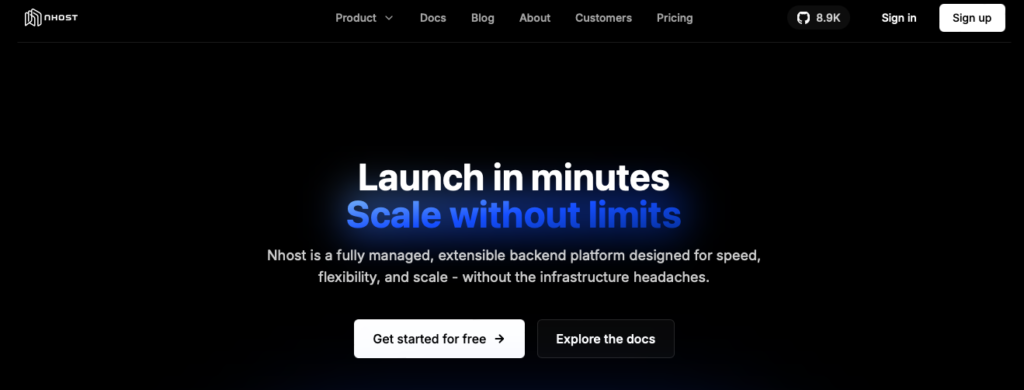
Nhost is a modern, open-source Backend as a Service (BaaS) platform built around PostgreSQL and GraphQL.
It provides a fully managed backend that eliminates the need for custom server code, making it a popular choice for teams building modern web and mobile applications using tools such as React, Vue, Next.js, React Native, Expo, and Flutter.
Based on a stack centered around Hasura, Postgres, serverless functions, and S3-compatible storage, Nhost delivers a complete backend environment with real-time capabilities, strong database modeling, and a seamless developer experience.
Its open-source foundation also makes it attractive to teams seeking transparency, flexibility, and vendor openness.
Core capabilities of NHost include:
- Managed PostgreSQL database
- Auto-generated real-time GraphQL API (Hasura)
- Authentication + fine-grained access rules
- Serverless functions
- S3-compatible file storage
- Real-time GraphQL subscriptions
- Open-source stack with self-host option
- Schema migrations and SQL-first workflows
Features
PostgreSQL Database (Fully Managed) – Nhost provides a production-grade Postgres database with schema support, relational data modeling, foreign keys, and SQL-based workflows.
GraphQL API (Powered by Hasura) – All database operations automatically become available through a real-time GraphQL API. This allows developers to query, mutate, and subscribe to data instantly without building API endpoints manually.
Authentication & Authorization – Nhost includes a built-in auth system with email/password login, magic links, social login (via OAuth providers), JWT-based sessions, and fine-grained access rules integrated directly with Hasura.
Serverless Functions – Developers can create serverless functions in TypeScript/JavaScript to handle custom logic, webhooks, backend processes, and third-party integrations. These functions are deployed automatically and run in a managed environment.
File Storage – Nhost provides an S3-compatible object storage system for uploading and managing files. Developers can customize access rules, handle uploads directly from the client, and integrate files with GraphQL metadata.
Real-Time Capabilities – Because Hasura powers Nhost’s GraphQL API, developers benefit from real-time subscriptions—ideal for live-updated dashboards, chat applications, collaboration tools, and event-driven apps.
Pricing Summary
Nhost offers a transparent, usage-based pricing structure:
- Free Tier – Intended for prototypes, learning projects, and small personal applications. Includes modest database capacity, storage, and bandwidth, making it suitable for early exploration and lightweight workloads.
- Pro Tier – Built for production environments. Offers expanded compute resources, increased storage and data allowances, automated backups, recoverability features, monitoring tools, and standard support options.
- Team Tier – Aimed at collaborative and compliance-focused organizations. Provides advanced access controls, enhanced support channels, extended GraphQL capabilities, and options for integrating external databases or meeting industry standards.
- Enterprise Plans – Fully customizable deployments with dedicated backend infrastructure, priority support, service-level guarantees, and security or compliance accommodations for large-scale or regulated applications.
Pricing scales based on database size, storage, function execution time, and data transfer. Nhost allows teams to start for free and scale predictably as their application grows.
AWS Amplify
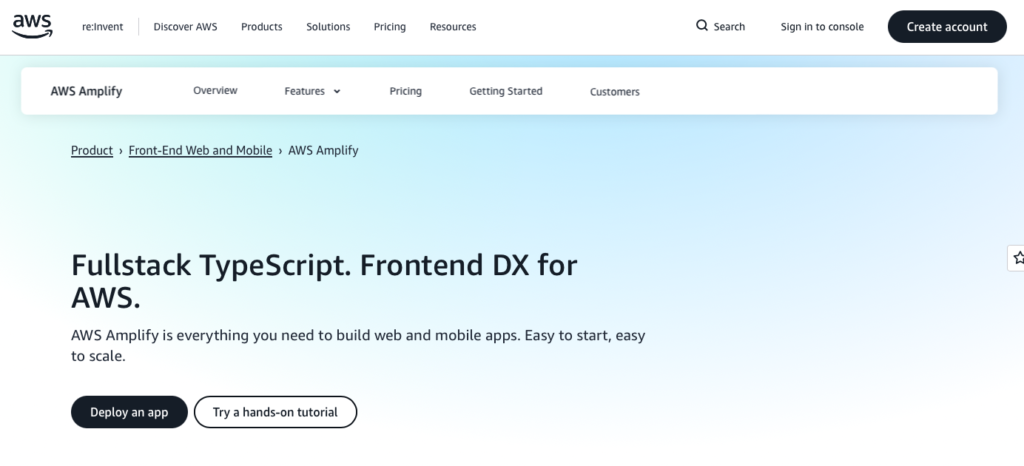
AWS Amplify is a full-stack backend as a service platform provided by Amazon Web Services. It offers a comprehensive suite of tools for building, deploying, and managing modern web and mobile applications without manually configuring backend infrastructure.
Amplify integrates deeply with the AWS ecosystem, making it a strong option for teams that require scalability, security, and global availability.
Core capabilities of AWS Amplify include:
- Rapid backend provisioning on AWS
- REST/GraphQL APIs (AppSync + Lambda)
- Authentication via Amazon Cognito
- Storage via Amazon S3
- Hosting + CI/CD with CDN delivery
- Offline-first sync (DataStore)
- Easy extension into full AWS ecosystem
- Pay-as-you-go scaling with AWS services
Features
Authentication and User Management – AWS Amplify includes built-in authentication and authorization powered by Amazon Cognito. It supports email-password logins, social providers (Apple, Google, Facebook, Amazon), multi-factor authentication, and advanced access-control configurations.
Data and APIs – Developers can create secure REST or GraphQL APIs backed by AWS AppSync and AWS Lambda. Amplify also provides DataStore, an offline-first data engine that syncs changes automatically between client and cloud—particularly useful for real-time, collaborative applications.
Storage and File Handling – File and media storage is handled through Amazon S3, allowing applications to upload, manage, and deliver assets efficiently.
Hosting and CI/CD – Amplify Hosting provides a fully managed hosting environment with continuous integration and delivery. It connects directly to GitHub, GitLab, or Bitbucket, automatically deploys updates on every commit, and serves applications through a global CDN.
Extensibility and Integrations – A major advantage of AWS Amplify is extensibility. Developers can add new backend resources (such as databases, functions, or queues) and integrate existing AWS infrastructure.
Pricing
AWS Amplify uses a pay-as-you-go model, allowing teams to start small and scale costs based on consumption.
- Free Tier: Includes a monthly allowance of build minutes, storage, and bandwidth—suitable for experimentation or low-traffic projects.
- Build and Deploy: Charged per build minute. Standard build instances cost roughly $0.01 per build minute beyond free-tier usage.
- Hosting: Storage and bandwidth are billed separately (e.g., approximately $0.023 per GB of stored content and ~$0.15 per GB served).
- Backend Services: Amplify orchestrates other AWS services such as Cognito, AppSync, DynamoDB, Lambda, and S3. These are billed according to their individual AWS pricing models.
Appwrite
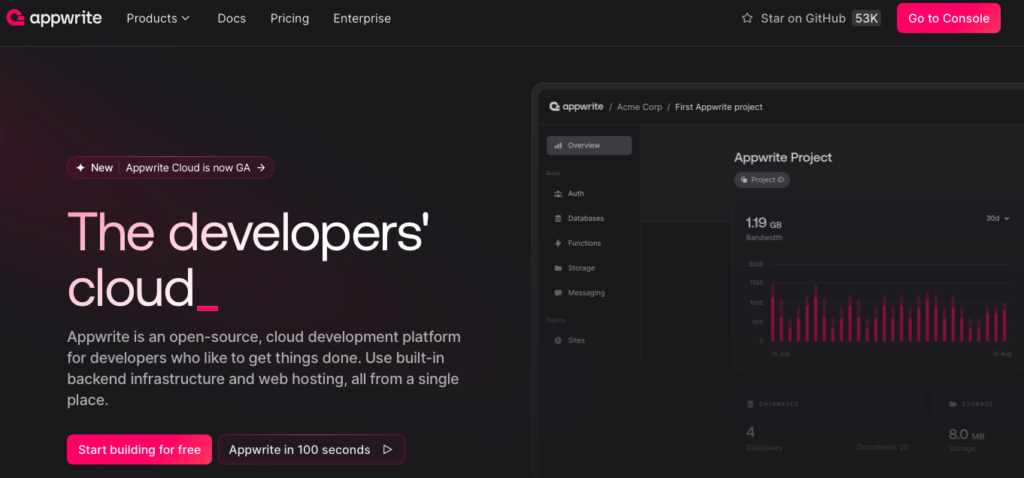
Appwrite is a modern open-source cloud development platform designed for teams that want a fully managed backend without giving up flexibility.
It provides the main building blocks needed to run mobile and web apps—Authentication, Databases, Storage, Functions, Realtime events, Messaging, and Sites—all accessible through REST APIs and a growing set of SDKs.
Appwrite also supports self-hosting, which makes it attractive for projects that need full infrastructure control or specific compliance requirements.
Core capabilities of Appwrite include:
- Open-source backend (cloud or self-hosted)
- Authentication + MFA + user management
- Document database with CRUD APIs
- File storage with access rules
- Serverless functions for backend logic
- Real-time subscriptions/events
- Messaging for push/email/SMS
- Frontend-friendly SDKs + REST API
Features
Authentication & User Management — Appwrite includes secure login flows with support for multi-factor authentication and role-based access patterns, helping teams implement sign-up, sign-in, and session management quickly.
Databases — Offers scalable databases with document-style data modeling, CRUD APIs, encryption options, and automatic backups on paid tiers.
File Storage — Built-in storage with access control and encryption, plus image transformation capabilities on cloud plans.
Serverless Functions — Deploy and scale backend logic using Appwrite Functions, enabling custom workflows without managing servers.
Realtime Subscriptions — Apps can subscribe to database, auth, and other events to receive live updates, supporting chat, collaboration, and real-time UI patterns.
Messaging — Provides a native messaging layer for push notifications, email, SMS, chat, and in-app notifications depending on plan limits.
Sites (Hosting) — Appwrite Sites acts like a lightweight deployment layer for web projects, positioned as an open-source alternative to platforms like Vercel, with SSR support now available.
Cloud or Self-Hosted — Teams can use Appwrite Cloud for convenience or self-host the open-source version with no licensing fees.
Pricing
Appwrite Cloud follows a tiered model.
- Free plan: Intended for learning, prototypes, and small apps. Includes access to all core Appwrite products, but with lower shared resource limits and a small cap on projects.
- Pro plan: Built for production applications. Provides much higher limits and resources to scale projects, plus the ability to keep apps running as usage grows (with overages/add-ons available) and stronger operational features like backups and support.
- Enterprise plan: Designed for large-scale or regulated workloads. Offers custom limits, premium support, uptime/SLA guarantees, advanced security and compliance options, and enterprise governance features
Kuzzle
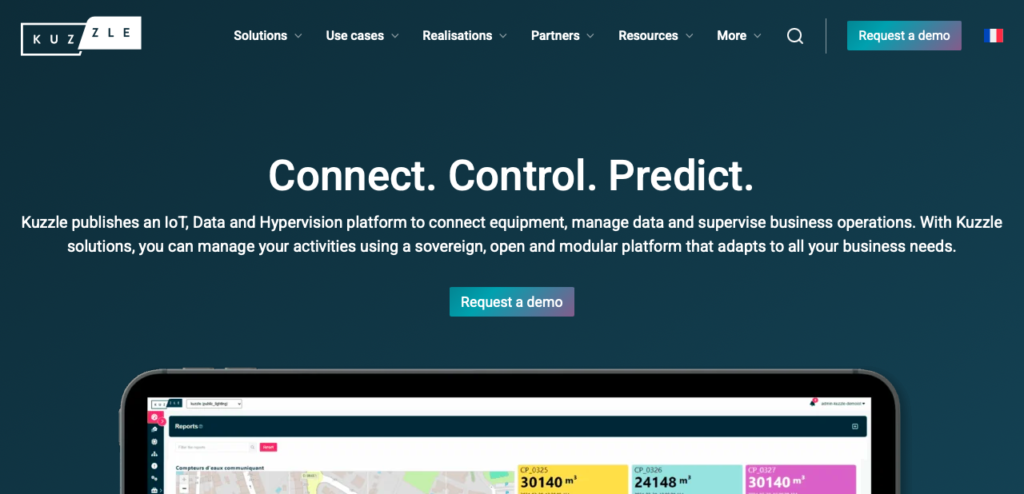
Kuzzle is an open-source platform–style platform with a strong focus on IoT, data and hypervision use cases.
Its ecosystem includes Kuzzle Backend, Kuzzle IoT, Kuzzle Data and Kuzzle Hypervision, which together provide a sovereign, modular stack to connect equipment, centralise heterogeneous data, and supervise operations across domains such as smart cities, smart buildings, logistics, industry and healthcare.
It can be deployed in the cloud or on-premises, making it suitable for organisations that require data sovereignty and infrastructure control.
Features
Open-source backend (Kuzzle Backend) – Provides a ready-to-use backend with a NoSQL database, multi-protocol API, admin console, real-time engine and extensible development framework, allowing custom business logic to be added in Node.js while keeping the core platform managed.
IoT platform (Kuzzle IoT) – Centralises the management of connected devices at scale, interoperating with multiple sensors, networks and protocols (such as LoRa, MQTT and HTTP).
Data platform (Kuzzle Data) – Acts as an open-source, sovereign data layer that ingests, structures and secures data from IoT sensors, business systems and external sources. It follows an API-first, interoperable architecture so data can feed analytics tools, dashboards or AI models while maintaining governance and compliance.
Hypervision platform (Kuzzle Hypervision) – Consolidates IoT data, business systems and repositories into unified, collaborative dashboards. It supports digital twins, cross-functional KPIs, automated scenarios and predictive insights to supervise multi-site operations and inform strategic decisions in real time.
Interoperability and modularity – Designed to integrate into existing environments rather than replace them. Organisations can start with a specific module (IoT, Data or Hypervision) and extend over time, adding new use cases, data sources or equipment as projects grow.
Deployment flexibility and sovereignty – Offers hosting on French sovereign cloud or local infrastructure (on-premise), giving organisations full control over where data resides and how it is governed, which is particularly relevant for public-sector and regulated industries.
Core capabilities of Kuzzle include:
- Open-source realtime backend for IoT and data
- NoSQL storage with multi-protocol APIs
- Real-time engine for live applications
- Modular stack (Backend, IoT, Data, Hypervision)
- Node.js extensibility for custom logic
- On-prem or cloud deployment options
- Search-heavy and device-driven workflows
- Admin console and monitoring tooling
Pricing
The pricing for Kuzzle is not publicly available.
Supabase
Supabase is a modern backend platform built around a fully managed Postgres database. It positions itself as a Firebase alternative while emphasizing SQL, portability, and developer control.
Supabase provides an integrated backend stack including database, authentication, instant APIs, real-time subscriptions, storage, and serverless functions.
Core capabilities of Supabase include:
- Managed PostgreSQL database with extensions
- Instant REST APIs + optional GraphQL
- Built-in auth with Row Level Security (RLS)
- Real-time subscriptions on Postgres changes
- Storage with CDN + image tooling
- Edge Functions (serverless TypeScript/Deno)
- Vector storage + AI integrations
- Cloud or self-host deployment paths
Features
Managed Postgres Database — Every project runs on a full Postgres instance with backups, extensions, connection pooling, and enterprise-grade reliability.
Instant REST & GraphQL APIs — Supabase automatically generates REST endpoints from your schema and also supports GraphQL via its Postgres GraphQL extension, enabling fast API delivery with minimal boilerplate.
Authentication with Row Level Security (RLS) — Built-in auth supports email/password, magic links, social OAuth providers, SSO/SAML on higher tiers, and integrates tightly with Postgres RLS policies to control access at the data layer.
Realtime Subscriptions — Supabase Realtime lets apps listen to Postgres changes (inserts/updates/deletes), and also includes Broadcast (low-latency client messaging) and Presence (sync online/active user state).
Edge Functions (Serverless) — Globally distributed Deno/TypeScript functions run close to users for low latency, with NPM compatibility and regional execution options.
Storage with CDN + Image Tools — S3-compatible object storage for files, images, and video, integrated with Postgres permissions via RLS. Includes CDN caching, resumable uploads, and on-the-fly image transformations.
Vector Database & AI Integrations — Supabase supports storing and querying vector embeddings inside Postgres, plus built-in AI integrations for ML-driven apps.
Pricing
Free — Intended for learning, prototypes, and small applications. Includes a limited number of projects and lower usage quotas across core services (database, storage, bandwidth, auth, realtime, and functions).
Pro — Designed for production applications that need higher limits, consistent performance, and no project pausing. Pro expands quotas across services and enables spend-control features.
Team — Built for organizations running multiple production projects and needing stronger collaboration and governance.
Enterprise — Custom plan for large-scale or regulated workloads. Offers negotiated limits, advanced security/compliance options, dedicated support, and optional SLAs.
PlayFab

PlayFab (Azure PlayFab) is a specialized backend as a service (BaaS) platform for games, built to manage live game operations, player identity, content, and multiplayer services at scale.
It provides a unified backend for studios developing across console, PC, and mobile, with infrastructure powered by Microsoft Azure’s global cloud footprint.
Core capabilities of PlayFab include:
- Managed game backend on Azure
- Player identity, accounts, and profiles
- LiveOps tools (events, catalogs, configuration)
- Real-time analytics and telemetry ingestion
- Multiplayer services (matchmaking, lobbies, servers)
- Party chat/voice + networking
- A/B testing and experimentation
- Usage-based scaling for live games
Features
Player Accounts & Identity — PlayFab handles player authentication and identity across titles and devices, enabling account linking and cross-platform progression. Identity tools also support secure player profiles and permissions.
Data, Events & Real-Time Analytics — The platform captures in-game events and telemetry so teams can monitor player behavior, balance gameplay, and optimize retention.
LiveOps & Game Configuration — Developers can run live events, update game rules, manage catalogs/economy, and roll out content without requiring app store releases. This is a core reason PlayFab is widely used for ongoing game management.
Multiplayer Services — PlayFab Multiplayer supports matchmaking, lobbies/parties, and server hosting. A key product is PlayFab Multiplayer Servers (MPS), which lets studios deploy custom dedicated servers that auto-scale with player demand using Azure compute.
Party (Voice/Text Chat + Networking) — Azure PlayFab Party provides low-latency voice, text chat, and data communication for multiplayer games, including cross-platform support.
Experiments / A-B Testing — Built-in experimentation tools allow studios to test features, monetization changes, and balance updates safely on subsets of players.
Pricing
The free development tier supports a limited number of titles and players per title, and includes a small allowance for multiplayer server testing.
Once a game exceeds the development limits, it must move to a live setup. For live games, PlayFab offers a pure usage-based option with no fixed commitment, as well as higher tiers that include bundled monthly usage allowances and upgraded support.
Across all live tiers, billing is driven by consumed backend services and multiplayer server usage, allowing costs to scale alongside player growth.
8Base
8Base is a serverless Backend as a Service (BaaS) platform built around a managed GraphQL backend. It generates a full CRUD GraphQL API from the data model, including queries, mutations, and real-time subscriptions, so teams can start building without setting up servers or writing boilerplate endpoints.
Core capabilities of 8Base include:
- Serverless GraphQL backend (managed cloud)
- Auto-generated CRUD GraphQL API
- Real-time subscriptions from schema
- Serverless functions (triggers, webhooks, jobs)
- Built-in filtering/search/pagination
- Optional low-code App Builder (frontend)
- AI planning support via Archie
- Per-project tiers + enterprise scale
Features
Auto-generated GraphQL API with built-in filtering, pagination, search, and CRUD operations for every table.
Real-time subscriptions automatically created from the schema for live data updates.
Custom serverless functions to extend backend behavior, including resolvers, triggers, webhooks, and background tasks.
App Builder (frontend) provides a drag-and-drop React environment with routing, components, styling, and secure connections to GraphQL or REST data sources.
Archie (AI Product Architect) helps turn an app idea into structured requirements and architecture outputs to speed up planning.
Pricing
- Free – Free entry tier for learning and small applications, with core GraphQL and serverless features.
- Professional – Developer and team tiers increase capacity and add collaboration and professional workflow support.
- Enterprise – Enterprise options provide dedicated environments, stronger governance, and enhanced support for large or regulated workloads.
Kii
Kii is a high-performance backend as a service (BaaS) designed primarily for IoT and connected-device applications.
It provides a fully managed backend that supports both mobile apps and device fleets, with flexible deployment in Kii’s public cloud or in a customer’s private environment.
This makes Kii a strong option for enterprises that need IoT scalability, device control, and regulatory-friendly data hosting.
Core capabilities of Kii include:
- Enterprise IoT backend platform
- Device/thing lifecycle management
- User management and authentication
- Scalable data ingestion/storage for fleets
- Push notifications and messaging
- Geolocation and tracking support
- Extension framework for custom logic
- Public cloud, private cloud, or on-prem deployment
Features
Thing Interaction Framework — Kii includes a dedicated framework for common IoT patterns, especially sensor → cloud → app workflows.
User Management — Provides built-in user onboarding and authentication. Teams can support logins via social providers, email/password, or SMS-based authentication, making it easier to manage access across companion apps and device users.
Data Management — Kii handles monitoring, usage scaling, and security provisioning automatically. Developers can organize and control data at multiple levels, including application, user, and group scopes, which is useful for multi-tenant or enterprise IoT deployments.
Device Management — Allows full lifecycle control of connected devices, including device registration, configuration management, and linking devices to users, datasets, and permissions.
Push Notifications — Supports targeted push messaging for engagement and device/app updates. Notifications can be used for alerts, status changes, promotions, or operational messaging tied to IoT events.
Geolocation — Built-in location services enable tracking and geo-based interactions, such as asset monitoring, check-ins, field workforce coordination, and location-triggered offers or updates.
Platform Extensions — Enables custom backend logic through extensions, letting teams adapt Kii to business rules without shipping a new app version. This adds flexibility similar to cloud code functions in other BaaS platforms.
Pricing
Kii pricing is not displayed publicly for users who are not logged in.
PocketBase
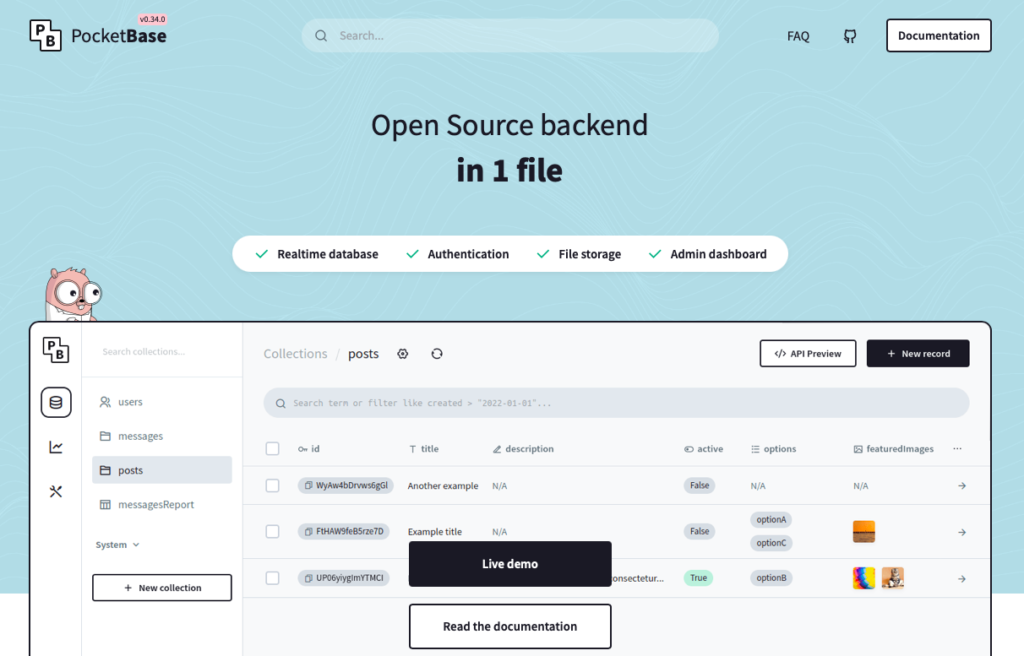
PocketBase is a lightweight, open-source backend as a service (BaaS) packaged as a single executable file.
Built in Go, it provides an embedded realtime database, authentication, file storage, and a built-in admin UI—so a complete backend can be running in minutes with minimal setup.
It is primarily self-hosted and popular for prototypes, MVPs, internal tools, and small apps that want Firebase-like convenience without managed-cloud lock-in.
Core capabilities of PocketBase include:
- Lightweight open-source backend
- Embedded SQLite database with realtime events
- Auto REST APIs from collections
- Built-in authentication and access rules
- File storage linked to records
- Admin dashboard out of the box
- Official SDKs for common frontend stacks
- Self-host anywhere with minimal infra
Features
Open-Source Backend in One File — The entire backend (API server, admin UI, and database layer) ships as one portable binary. This makes local development and deployment extremely simple compared to multi-service stacks.
Realtime Database (SQLite Embedded) — PocketBase includes an embedded SQLite database plus a schema builder, validations, and realtime subscriptions for listening to data changes. It exposes data through a REST-style API and live events.
Authentication & User Management — Built-in auth supports email/password flows and OAuth2/social providers, with user collections and role-based access rules. This removes the need to wire up a separate auth service.
File Storage — Provides native file upload handling linked to records. Files can be stored locally or routed to S3-compatible storage for more scalable setups, while keeping the same API surface.
Admin Dashboard (Out of the Box) — A built-in web dashboard lets teams manage collections, records, users, access rules, and files without extra tooling. This is one of PocketBase’s biggest productivity wins.
SDKs + Frontend-Friendly APIs — Official SDKs (including JavaScript and Dart) make it easy to integrate PocketBase with React, Vue, Svelte, Angular, Flutter, and other frontend stacks.
Extensible as a Go Framework — Beyond running as a standalone backend, PocketBase can be imported as a Go library so teams can add custom routes, hooks, or business logic while still shipping a single executable.
Pricing
Because PocketBase is open-source, teams can host it on AWS, Google Cloud, Azure, DigitalOcean, or any containerized environment—providing maximum control, compliance support, and cost flexibility.
Xano
Xano is a backend as a service (BaaS) platform focused on building production-grade backends with a visual interface, optional code control, and new AI-native components.
In its 2.0 release, Xano positions itself as a unified solution for APIs, data modeling, server-side logic, and auto-scaling infrastructure, supporting everything from customer apps to intelligent agents.
Core capabilities of Xano include:
- Visual no-code/low-code backend builder
- Managed PostgreSQL database
- Instant REST APIs from data models
- Function Stack for server logic + workflows
- Background tasks + edge functions
- Built-in auth, RBAC, and compliance posture
- AI integration via MCP Server
- Native AI Agent builder and orchestration tools
Features
Visual Logic Builder (Function Stack) – Server-side workflows can be built and maintained visually via Xano’s Function Stack, making API logic clear and editable for mixed-skill teams.
Hybrid Development: Visual + Code + AI – Xano 2.0 supports building logic through three modes—visual, AI-assisted, or code (XanoScript)—with seamless switching between them.
Instant REST APIs + MCP for Agent Connectivity – APIs can be generated rapidly and exposed not only to frontends but also to AI systems via Xano’s MCP Server, enabling agent-friendly tool use and backend interaction.
Managed Postgres Database – A built-in, fully managed PostgreSQL database powers structured storage, triggers, and automations without DevOps overhead.
AI Agent Builder + Memory/Orchestration – Xano includes modular AI components for building agents with memory, tool calls, and runtime control inside backend workflows.
Background Tasks & Edge Functions – Serverless background jobs and edge functions support asynchronous processing and low-latency execution at scale.
Security, RBAC, and Compliance – Built-in authentication, role-based access control, and compliance posture (including GDPR and SOC/ISO on higher tiers) make it suitable for regulated workloads.
Auto-Scaling Infrastructure – Workspaces are containerized and run on managed, auto-scaling infrastructure with observability/monitoring included.
Pricing
- Build (Free): For prototyping and testing. Core visual backend builder, API publishing, managed database, and limited AI/agent tools. Rate limits and resource caps apply.
- Starter: For production launch. Higher compute/storage, no API rate limits, unlimited records, branching, background tasks, GDPR features, and rolling backups.
- Pro: For scaling teams. Dedicated infrastructure, multiple workspaces, team seats, advanced RBAC, stronger compliance, better backups, and higher uptime/SLA.
- Custom / Enterprise: For large or regulated deployments. Unlimited scale, self-hosting/BYOC/on-prem, multi-tenant support, sidecar containers, SSO, advanced logging/monitoring, and dedicated support.
Directus
Directus is an open-source backend as a service (BaaS) and headless content/data platform that turns any SQL database into a production-ready backend.
Teams can visually model data, instantly generate REST and GraphQL APIs, manage users and permissions, and provide a clean admin interface for non-technical stakeholders.
Directus can run as a managed cloud service or be fully self-hosted, giving developers full control over infrastructure and data ownership.
Core capabilities of Directus include:
- Open-source layer for any SQL database
- Instant REST and GraphQL APIs
- Visual data modeling + admin studio
- Built-in auth, RBAC, and policy rules
- No-code Flows for automation
- Realtime via WebSockets/subscriptions
- Extension system for custom endpoints/UI
- Managed cloud or full self-hosting
Features
Connect Any SQL Database — Directus sits on top of existing databases (Postgres, MySQL, SQLite, SQL Server, etc.) and mirrors schemas automatically.
Instant REST + GraphQL APIs — Once the database is connected, Directus auto-generates a dynamic REST API and a real-time GraphQL schema that stay in sync with the data model.
Policy-Based Auth & RBAC — Directus includes built-in authentication and granular role-based access control. Permissions can be defined at collection, field, and action levels, supporting secure multi-user apps and internal tooling.
Data Studio / Admin App (No-Code UI) — Directus ships with a customizable admin panel (“Data Studio”) for managing content, users, files, and workflows.
Flows & Automation — The platform supports no-code/low-code automation via Flows, allowing teams to trigger actions, approvals, notifications, and integrations without writing server code.
Extensible via Custom Extensions — Directus is modular and supports custom endpoints, hooks, dashboards, interfaces, and workflows through extensions.
Realtime Updates — Directus provides real-time capabilities through WebSockets and GraphQL subscriptions, useful for dashboards, collaboration tools, and live apps.
Pricing
Directus offers two deployment paths—self-hosted and Directus Cloud (managed hosting)—with licensing and plan options depending on usage and organization size.
- Self-Hosted (Community / Free Use) – Directus is open-source and can be run on your own infrastructure at no cost for individual developers, hobby projects, and many small businesses.
- Self-Hosted (Commercial License) – Organizations that exceed the free-use thresholds or need Directus for broader commercial use can purchase a commercial license.
- Directus Cloud – Starter – Entry managed tier for small production apps and lightweight deployments. It includes hosted Directus with a managed database, file storage, and caching, intended for teams that want to avoid DevOps overhead.
- Directus Cloud – Professional – Production tier for growing products. Provides higher performance ceilings, more usage capacity, and broader operational features than Starter, aimed at apps expecting steady traffic and larger datasets.
- Directus Cloud – Enterprise – Custom, high-scale plan for regulated or large organizations. Includes dedicated support, advanced security/compliance options, uptime guarantees, and negotiated infrastructure limits.
Convex
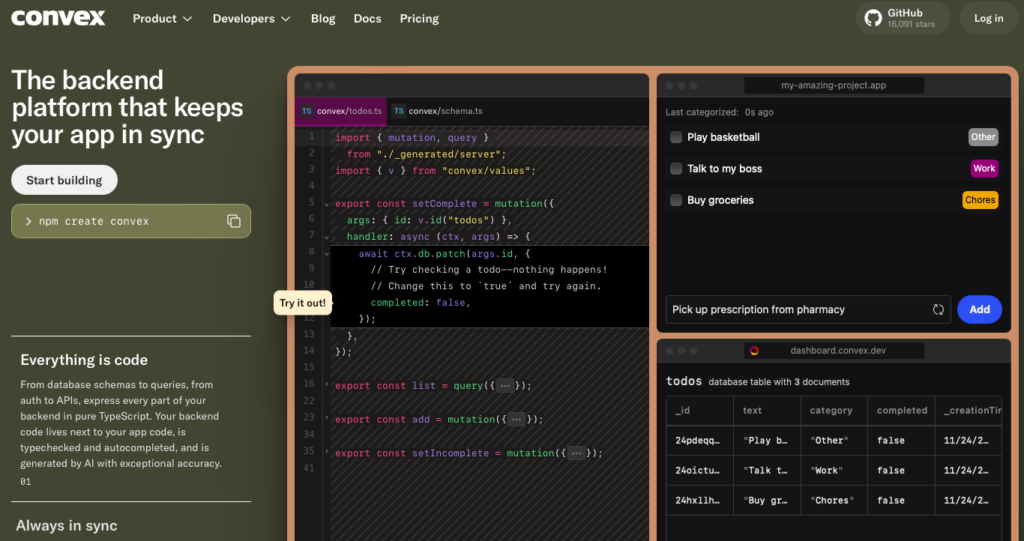
Convex is a modern backend as a service (BaaS) built around a reactive, realtime database and TypeScript-first server functions.
Instead of stitching together separate database, serverless functions, and websocket layers, Convex keeps frontend clients automatically in sync with backend data changes.
Developers write queries, mutations, cron jobs, and business logic in pure TypeScript, with end-to-end type safety and autocompletion.
Convex is offered as a managed cloud platform, and its backend is also open source with an official self-hosting option for teams that want to run Convex on their own infrastructure.
Core capabilities of Convex include:
- Managed reactive realtime database
- TypeScript-first backend functions
- Automatic client sync without websockets setup
- Queries, mutations, actions, and cron jobs
- Built-in auth with OAuth ecosystem
- Observability + production integrations
- Self-hosting option
Features
Reactive Realtime Database (“Always in Sync”) — Convex automatically pushes data changes to subscribed clients in realtime without manual cache invalidation or custom websocket code.
Everything as TypeScript Code — Database schema, queries, mutations, background jobs, and APIs are authored in TypeScript.
Serverless Functions: Queries, Mutations, Actions — Convex provides built-in primitives for reading (queries), writing (mutations), and side-effect/outbound work (actions).
Convex Auth with 80+ OAuth Integrations — Authentication leverages the Auth.js ecosystem to deliver 80+ OAuth providers out of the box, plus email/password and magic-link flows.
Convex Components (Modular Backend Building Blocks) — Components are reusable, sandboxed TypeScript modules that ship with strong guarantees (isolated execution, explicit permissions, transactional storage) and can be installed like npm packages to add backend functionality quickly.
Built-in Scheduling / Cron Jobs — Native cron and job scheduling lets teams run periodic or delayed backend work (cleanup tasks, notifications, pipelines) without a separate scheduler service.
AI-Friendly Backend Development — Because the entire backend is TypeScript, Convex integrates cleanly with AI coding tools.
Open Source + Self-Hosting — Convex’s core backend is open source, and there’s an official self-hosting path using Docker.
Production Integrations & Observability — Convex supports integrations for log streaming and exception reporting (e.g., Datadog, Axiom, webhooks), helping teams monitor deployments in production.
Enterprise Compliance — Convex states SOC 2 Type II compliance, HIPAA support, and GDPR verification, which is important for regulated workloads.
Pricing
- Free / Pay as you go — Built for personal projects, MVPs, and prototypes. Includes core Convex features (realtime database, functions, auth, file storage, scheduling, etc.) with baseline resource quotas.
- Professional — Intended for production apps and growing teams. Adds collaboration and operational features (team permissions, custom domains, observability/logging, preview deployments, higher concurrency, and larger built-in resources). workflows.
CloudKit
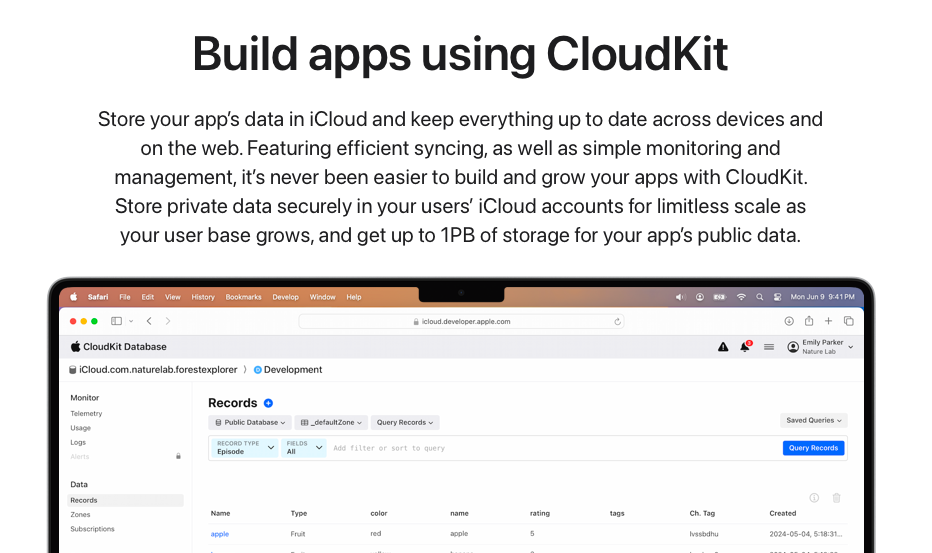
CloudKit is Apple’s native backend as a service (BaaS) framework built on iCloud. It enables developers to store app data securely in iCloud and sync it across Apple platforms like iOS, iPadOS, macOS, watchOS, tvOS, visionOS—and also on the web through CloudKit JS.
CloudKit is particularly attractive for teams building within the Apple ecosystem and wanting deep OS-level integration without managing infrastructure.
Core capabilities of CloudKit include:
- Apple iCloud-native managed backend
- Public/private/shared record databases
- Automatic sync + offline conflict handling
- Native Apple security tied to Apple ID
- CloudKit Console for schema + telemetry
- Deep integration across Apple platforms
- Web access via CloudKit JS
- Fully managed scaling inside Apple infra
Features
Public, Private & Shared Databases — Each CloudKit container provides a public database shared across users, private databases per user, and shared databases for collaborative data.
CloudKit Console (Dashboard) + Telemetry — The CloudKit Console is a web control panel where developers manage containers, schema, environments (development/production), records, and server activity. It also includes telemetry to monitor database usage and performance trends.
Offline Sync & Conflict Handling — CloudKit is designed around automatic syncing between devices, so apps can keep working offline and reconcile changes when connectivity returns.
Native Apple Security & Privacy — Data is tied to the user’s Apple ID and protected by iCloud security. Apple positions CloudKit as a privacy-focused backend with strong authentication and platform-level safeguards.
CloudKit JS + Web Services — CloudKit can power web apps using CloudKit JS and server-to-server APIs. This makes it possible to build Apple-backed web experiences that read/write CloudKit data, useful for companion web dashboards or cross-platform access.
Scales Automatically Inside Apple’s Infra — CloudKit is fully managed by Apple and scales without developer ops work. Apps benefit from Apple’s global infrastructure and tight integration with OS.
Pricing
CloudKit pricing is not displayed publicly for users who are not logged in.
Backend as a Service Comparison
| Provider | Database | Hosting | Pricing | Best For |
|---|---|---|---|---|
| Back4app | MongoDB | Fully managed cloud; dedicated and on-prem/BYOC options | Free tier + predictable tiers; usage scales by requests/storage/compute | Fast MVPs, teams wanting predictable BaaS costs |
| Firebase | NoSQL: Firestore + Realtime Database | Fully managed on Google Cloud (Firebase Hosting + Cloud Functions) | Free “Spark” + pay-as-you-go “Blaze” | Mobile/web apps needing realtime + tight Google ecosystem fit |
| Parse (Server) | BYO database (commonly MongoDB and Postgres; can vary by adapter) | Self-host anywhere or via managed hosts (e.g., Back4app) | Open-source framework; infra cost depends on host | Teams needing open source + full infra control |
| Backendless | Managed DB | Cloud, dedicated, or on-prem deployments | Free + cloud usage tiers + Pro/Enterprise options | Low-code full-stack apps, realtime + visual logic |
| NHost | Managed Postgres | Managed cloud + open-source self-host | Free + usage-based Pro/Team/Enterprise | GraphQL-first Postgres apps, Hasura fans |
| AWS Amplify | Typically DynamoDB via AppSync; can connect other AWS DBs | Fully managed on AWS (Hosting, CI/CD, Functions) | Pay-as-you-go + AWS Free Tier | Apps already on AWS needing quick backend + hosting |
| Appwrite | MariaDB | Appwrite Cloud or self-host | Free + Pro + Enterprise | Open-source Firebase alternative; teams wanting self-host option |
| Kuzzle | NoSQL | Primarily self-hosted; managed available via vendor/partners | Open-source; managed pricing not public | IoT, realtime + search-heavy apps, data sovereignty |
| Supabase | Managed Postgres | Supabase Cloud + self-hosting supported | Free + Pro/Team + Enterprise (hybrid base+usage) | SQL-first apps, teams wanting Firebase-like DX on Postgres |
| PlayFab | Managed game data stores on Azure | Fully managed Azure game backend | Free dev tier; usage-based live tiers | LiveOps + multiplayer game backends |
| 8Base | Managed relational DB + auto GraphQL | Fully managed cloud | Free + paid per-project tiers + Enterprise | Rapid GraphQL backends, low-code with optional frontend builder |
| Kii | Managed IoT-oriented backend DB | Public cloud, private cloud, or on-prem | Pricing not public; enterprise/IoT-scale contracts | Enterprise IoT fleets, connected-device apps |
| PocketBase | Embedded SQLite | Self-host | Open-source; infra cost depends on host | Tiny backends, prototypes, internal tools |
| Xano | Managed Postgres | Fully managed cloud; enterprise self-host/BYOC | Free + Starter/Pro/Custom tiers; scaling via add-ons/usage | Production no-code/low-code APIs, AI-agent backends |
| Directus | Any SQL DB (BYO Postgres/MySQL/etc.) | Directus Cloud or self-host | Free self-host community + paid cloud/enterprise | Headless CMS + data backend on existing SQL |
| Convex | Managed realtime transactional DB | Managed Convex Cloud + official self-host path | Free + Pro per-dev + usage scaling | Realtime TypeScript apps needing reactive sync |
| CloudKit | Apple CloudKit record DB (public/private/shared zones) | Fully managed inside iCloud | Pricing not public on the not logged area | Apple-ecosystem apps needing seamless iCloud sync |
Which is the Best Backend as a Service (BaaS) Platform for You?
Best BaaS for Startups (Free/MVP)- Top picks: Back4app, Firebase, Supabase.
Recommendation: Back4App is the most balanced startup choice for fast MVPs, realtime features, predictable pricing, and AI-ready tooling. Use Firebase for Google-native/mobile-first stacks, and Supabase for SQL/Postgres-first apps.
Best BaaS for Enterprise/Compliance – Top picks: Back4app, AWS Amplify, Kii.
Recommendation: Back4App is best when you want managed BaaS + dedicated/BYOC/on-prem flexibility. AWS Amplify is best for AWS-standardized enterprises, and Kii for large IoT/compliance-heavy deployments.
Best BaaS for Open-Source/Self-Hosting – Top picks: Parse, Directus, Appwrite.
Recommendation: Parse is the most complete self-hosted BaaS framework. Directus is best for SQL databases needing instant REST/GraphQL + admin UI, and Appwrite for a Firebase-like open-source alternative.
Best BaaS for AI – Top picks: Back4app, Firebase, Xano.
Recommendation: Back4App is the strongest realtime + AI pick thanks to native MCP Server and AI Agents plus realtime backend fundamentals. Choose Firebase for realtime apps on Google’s stack, and Xano for visual AI workflow/agent backends.
Conclusion
Choosing the best BaaS in 2026 comes down to matching platform strengths with product reality: data model, speed of delivery, and the level of control required over infrastructure.
Some providers optimize for rapid MVPs with minimal backend work, others prioritize compliance and enterprise deployment models, and a third group focuses on open-source portability or realtime-first experiences.
The right choice is the one that supports current build velocity while still scaling cleanly into production and future features like automation or AI workloads.
Across the comparison, Back4app stands out as the most complete all-around option: a managed realtime MongoDB backend, auto-generated REST/GraphQL APIs, low-code tools, and predictable scaling, plus native AI readiness through MCP Server and Native Agents.
Firebase and Supabase remain strong alternatives when their ecosystems are a direct fit—Firebase for Google-centric realtime apps, and Supabase for SQL/Postgres-first teams.
For organizations that need self-hosting and full ownership, Parse, Directus, and Appwrite offer the most flexibility.
Overall, the best BaaS is the one that reduces backend burden now, avoids architectural dead-ends later, and aligns with how the application is expected to grow.
FAQ
What is Backend as a Service (BaaS)?
Backend as a Service (BaaS) is a cloud model that provides ready-made backend features such as databases, authentication, APIs, cloud functions, and hosting. Using a BaaS platform helps developers avoid managing servers, scaling infrastructure, or writing repetitive backend code—speeding up development and reducing costs.
What are the best backend as a service providers in 2026?
For overall flexibility and features, Back4app is frequently cited as a best backend as a service provider alongside Firebase and Supabase. The best choice ultimately depends on your project’s database needs (Postgres vs. NoSQL) and hosting preferences (cloud vs. self-host).
What is the difference between BaaS and serverless?
BaaS platforms provide pre-built backend features such as databases, authentication, and API endpoints. Serverless focuses on running custom backend code without managing servers.
– BaaS = Prebuilt backend + managed infrastructure
– Serverless = Write your own logic, and cloud runs it automatically
Many modern backend as a service platforms combine both models.
Which BaaS platform is best for startups?
Back4app, Supabase, and Firebase are top choices for startups because they offer generous free tiers, fast implementation, and scalable backend services. These platforms help early-stage teams launch quickly without investing in DevOps or backend engineering.
Which is the most scalable backend as a service provider?
Back4app, AWS Amplify, and Firebase are among the most scalable backend as a service solutions. They support high-traffic workloads, offer automatic scaling, and provide global infrastructure options for performance and reliability.
Which BaaS is best for AI applications?
Back4app is a strong AI-ready BaaS because it provides a native AI agent experience plus an MCP Server, letting AI tools securely create and manage databases, APIs, and backend logic on your behalf.