Discovering an appropriate backend for Swift applications is paramount for Apple developers to build flexible, scalable, and highly tailored applications.
Swift is a robust, multi-paradigm, and compiled scripting technology launched in 2014. Apple completely endorses this general-purpose programming language to build lightning-fast macOS, watchOS, iOS, tvOS, and iPadOS applications.
Swift’s simple learning curve, regular updates, stability, and beginner-friendly nature make it an ideal option for many Apple programmers.
However, using this iOS language with the right backend solution is equally essential to achieve maximum outcomes.
That is why this article will share a variety of Swift backend options and their features. We will also give a quick overview of setting up a Swift app’s backend.
Open-source Backend as a Service (BaaS) solutions have streamlined the development of mobile and web applications in the past few years.
This cloud computing model confers a complete set of server-side functionalities to build and deploy backends robustly. That is why the popularity of BaaS platforms is climbing.
According to a forecast report by Allied Market Research, the Backend as a Service (BaaS) market will hit 28.7 billion USD at the end of 2032. This value was 3.1 billion USD in 2022. It signifies the growth of the BaaS industry with a CAGR of 25.3% in ten years.
Similarly, MarketsandMarkets projects the BaaS market size to be around 9.2 billion USD by 2028. This report anticipates a CAGR of 17.5% from 2023 to 2028.
However, businesses and dev teams prefer using open-source BaaS platforms because of their benefits. Some prominent features are no vendor lock-in, cost efficiency, flexibility, easy customization, and community support.
So, you must consider this guide if you are a backend engineer or a company looking for a Backend as a Service (BaaS) open-source solution.
We will thoroughly discuss the leading options, traits, and perks of using open-source cloud computing platforms.
AI coding assistants are a type of software development tool intended to make coding processes faster and easier. These assistants rely on artificial intelligence to help developers generate, fix, or adjust code. They usually integrate with popular IDEs (development environments) and work in real time.
A major function of AI coding assistants is to offer suggestions for code completion, which is possible given their ability to understand the context of code. These assistants typically use large language models (LLMs) to analyze large code repositories and identify relevant patterns, and solutions for a given code snippet or function.
AI coding assistants are especially useful for speeding up the process of writing code through automation. Developers often use them to carry out repetitive or simple but time-consuming tasks, or to highlight issues. However, they cannot reliably replace the human input and still require some level of expertise to create accurate and safe code.
The best Python hosting providers in 2026 are Back4app (managed containers with a free tier), Heroku (classic git-push deployment), DigitalOcean App Platform, PythonAnywhere (Python-specialist hosting), Render, and Google App Engine — with Kamatera, Linode, AWS, and Railway rounding out the top ten. The right choice depends on whether you want a managed platform or raw infrastructure.
Provider
Free tier
Best for
Back4app
Yes
Managed Python backends deployed from GitHub
Heroku
No (low-cost plans)
Classic PaaS git-push workflow
DigitalOcean App Platform
Static sites only
Simple managed apps on DO infrastructure
PythonAnywhere
Yes
Beginners and small Django/Flask apps
Kamatera
30-day trial
Configurable cloud VMs
Render
Yes
Modern PaaS with autodeploy from Git
Google App Engine
Free daily quota
Autoscaling on Google Cloud
Linode (Akamai)
Trial credits
Predictable VM pricing
AWS
12-month free tier
Maximum service breadth
Railway
Trial credits
Fast prototyping with modern DX
In this piece, we’re diving into the world of Python hosting. We’ll unveil ten top-tier Python hosting providers, shining a light on their key features and breaking down their cost structures. Come explore with us!
Python is one of the most widely used scripting languages. Developers like using Python for web development, software creation, data engineering, data visualization, task automation, and machine learning projects.
With a massive increase in the use of Python, choosing the most dedicated hosting services for such projects is also significant.
Therefore, this guide presents one of the best Python hosting providers with their features and pricing models. This article will also update the readers on the advantages and limitations of using Python.
Key Takeaways
Python is a popular, user-friendly language, ideal for various applications like web development and machine learning, but it’s more beneficial for backend development.
Python is easy to learn and write, highly productive, and has seamless debugging due to its interpreted nature. However, it’s slower, memory-intensive, and prone to runtime errors.
From niche services like Back4app, Heroku, and PythonAnyWhere, to industry titans like AWS and Digital Ocean – here’s our curated list of top ten Python hosting providers.
Next.js is getting very famous as a solution to build solid and effective web sites. It offers fast development and this is one of the reasons why most developers love to use it in their development projects.
However, it is not an easy task to look for an authentic hosting provider for next.js. This is because developers always want a hosting provider that offers all the features without overpaying.
Here we have brought a list of best hosting providers for Next.js sites to make things easier for you.
Ruby on Rails is a great programming language for building web applications. Developers who use this programming language for their development are very satisfied.
Developers love simple syntax and the wide range of Ruby Gems available. These features can manage almost half the challenge of creating a web app.
Finding the right hosting provider for your Ruby on Rails project is the next step here.
FastAPI is a powerful web framework. It was created in 2018 to help build RESTful APIs using Python.
The recent survey of Stack Overflow listed FastAPI among the most popular frameworks, with 7.42% votes of respondents. Although the use of FastAPI is snowballing because of its robustness, but it is still knotty to choose the right FastAPI hosting provider.
Its popularity is growing quickly due to its strength. However, it can still be difficult to find the right hosting provider for FastAPI. Here we will highlight the best FastAPI hosting providers for you.
Backend frameworks bestow primary structure for developing mobile and web applications.
These pre-built components revolutionize how business logic is added, databases are handled, user management is performed, and server-side functionalities are further improved.
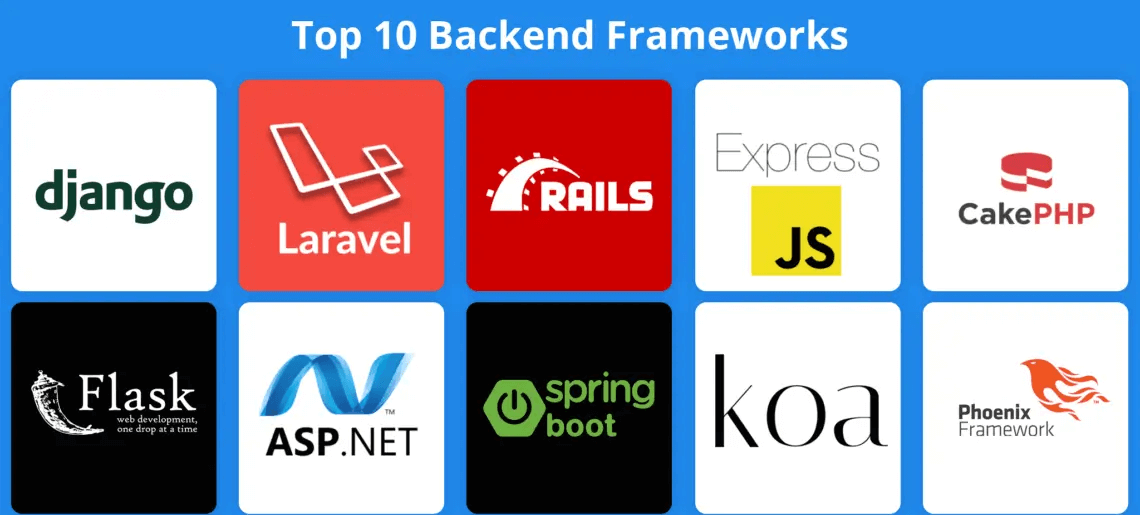
Hereof, Laravel, Spring Boot, RoR, Django, ExpressJS, and Asp.NET Core are highly acclaimed programming frameworks.
However, it is still crucial to employ the most suitable option that meets the demands of your project.
Indeed, choosing the right backend framework is significant in building high-performing, secure, and scalable web and mobile applications.
Thereby, this guide will discuss the best backend frameworks and their key features and limitations.