Best Backend as a Service (BaaS) Providers in 2026: Top Platforms Compared

The best Backend as a Service providers in 2026 are Back4app (open-source-based, relational data, containers), Firebase (Google ecosystem), AWS Amplify, Supabase, Appwrite, and Backendless — with Parse, NHost, Kuzzle, and PlayFab serving more specific needs. The full comparison below covers features, pricing, and ideal use cases for each.

Last reviewed November 2025 with 2026 pricing/features. New to the category? Our guide on how to choose a backend for your app explains the criteria behind this list.

This comprehensive backend as a service (BaaS) platform comparison reviews the best BaaS providers and leading cloud backend platforms in 2026.

It meticulously compares key features of the top vendors, including database models, hosting flexibility, AI support, pricing approaches, and best-fit use cases to help development teams choose the right managed backend. The goal is to determine which platform truly offers the best backend as a service for your specific project.

The guide covers modern managed backend services, serverless backend platform features, and no-code/low-code backends used for mobile and web applications, ensuring you find the right backend as a service provider whether you are building a fast MVP or a high-scale enterprise application.


The 10 Best Firebase Alternatives in 2026 (Open-Source, Cheaper & Self-Hosted Options)

Firebase alternatives

Last updated: January 2026

Looking for the best Firebase alternatives in 2026? This guide explores the top 10 platforms that developers are adopting to overcome Firebase’s challenges—such as vendor lock-in, unpredictable pricing, and limited hosting flexibility.

We’ll highlight industry-leading solutions like Back4App, AWS Amplify, Backendless, Kuzzle, Supabase, Appwrite, Nhost, Xano, PocketBase, and Hasura. Each offers distinct advantages, from open-source transparency and multi-cloud deployment to SQL support, GraphQL APIs, and real-time functionality.

Whether you’re building mobile, web, or IoT applications, this comparison will help you identify the right backend platform to scale your app efficiently while maintaining control and cost predictability.


Create Mobile Apps Faster with AI and Smarter Tools

Speed matters when you’re building mobile apps. The faster we can get a working version out into the real world, the sooner we can collect feedback, make changes, and stay ahead of shifting user expectations. These quick cycles give teams a real edge.

One big reason development moves faster now is because of backend as a service. Instead of writing every part of an app by hand, developers can plug into ready-made backend tools and get going without delay.

Add artificial intelligence into the mix, and we get next-level benefits. AI tools inside backend platforms are helping developers build smarter and fix problems sooner, without getting stuck on backend complexity.


Back4app Is HIPAA Compliant

Back4app now meets one of the toughest U.S. healthcare standards—HIPAA—and this compliance is available exclusively on our Dedicated plan.

For builders, that means a backend legally cleared to store, process, and transmit Protected Health Information (PHI) without extra servers or bolt-on security layers.

Skip the compliance scramble and focus on delivering patient-centric features; we’ve completed the risk analyses, paperwork, and audits so you don’t have to.


Back4app Is SOC 2 & ISO 27001 Compliant

Back4app now carries two heavyweight endorsements—SOC 2  Type 1 and ISO  27001—and they are available on both Pay‑as‑you‑go and Dedicated plans.

For users, that means a backend that already satisfies trusted standards for reliability, data integrity, and operational excellence.

Skip the spreadsheet marathon of security questions and focus on shipping features your users love; we’ve handled the paperwork and the pen‑tests so you don’t have to.


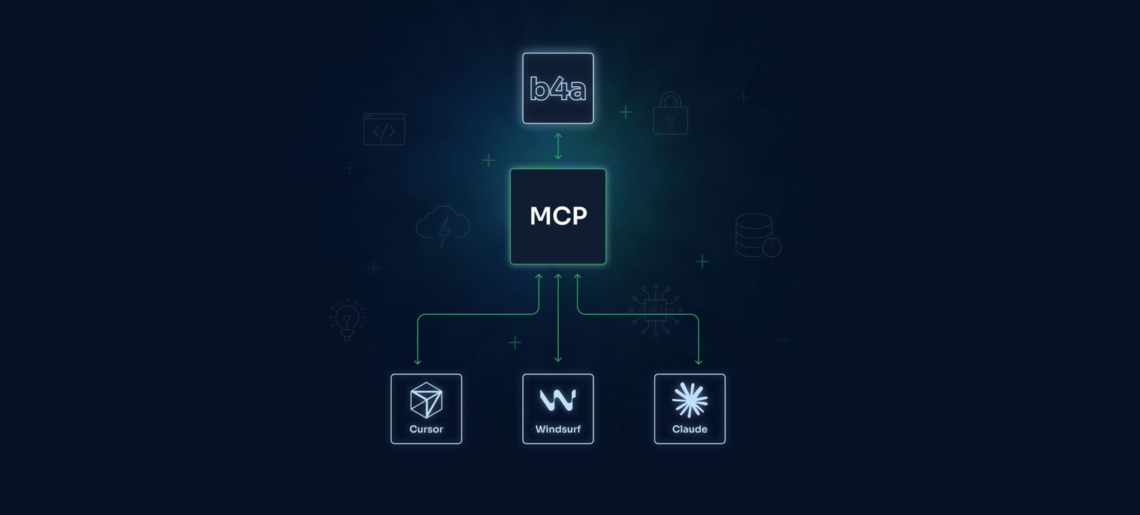
Back4app MCP Server: Give AI agents backend superpowers

#image_title

Back4App has long focused on simplifying backend development through its Backend-as-a-Service platform. In 2023, we launched the Back4App Autonomous Agent, essentially “AutoGPT for developers,” which could transform natural language instructions into actual running backend tasks.

Now we’re taking the next step. We’re proud to announce the Back4App MCP Server, which opens our platform’s capabilities through an open standard – allowing AI agents that speaks the Model Context Protocol (MCP) to interact with Back4App. Whether you use Cursor IDE, Windsurf, Claude(Desktop or Code), or other MCP-compatible assistants, they can now manage your Back4App resources directly.


What’s New in Continuous Delivery? Trends and Predictions for 2025

Continuous delivery is a software development practice where code changes are automatically prepared for a release to production. It expands upon continuous integration by deploying all code changes to a testing environment and then to a production environment after the build stage. When properly implemented, it ensures developers always have a deployment-ready build artifact that has passed through a standardized test process. 

Continuous delivery encourages developers to automate testing beyond simple unit tests so they can verify application updates across multiple dimensions before deploying to customers. These tests may include UI testing, load testing, integration testing, API reliability testing, etc. This helps developers more thoroughly validate updates and pre-emptively discover issues. 

With cloud environments, it is easy and cost-effective to automate the creation and replication of multiple environments for testing, which was previously difficult to do on-premises.


Best Backend for a Swift App

Discovering an appropriate backend for Swift applications is paramount for Apple developers to build flexible, scalable, and highly tailored applications.

Swift is a robust, multi-paradigm, and compiled scripting technology launched in 2014. Apple completely endorses this general-purpose programming language to build lightning-fast macOS, watchOS, iOS, tvOS, and iPadOS applications. 

Swift’s simple learning curve, regular updates, stability, and beginner-friendly nature make it an ideal option for many Apple programmers.

However, using this iOS language with the right backend solution is equally essential to achieve maximum outcomes. 

That is why this article will share a variety of Swift backend options and their features. We will also give a quick overview of setting up a Swift app’s backend. 

Let’s kick things off.


Backend as a Service Open Source

Open-source Backend as a Service (BaaS) solutions have streamlined the development of mobile and web applications in the past few years.

This cloud computing model confers a complete set of server-side functionalities to build and deploy backends robustly. That is why the popularity of BaaS platforms is climbing.

According to a forecast report by Allied Market Research, the Backend as a Service (BaaS) market will hit 28.7 billion USD at the end of 2032. This value was 3.1 billion USD in 2022. It signifies the growth of the BaaS industry with a CAGR of 25.3% in ten years.

Similarly, MarketsandMarkets projects the BaaS market size to be around 9.2 billion USD by 2028. This report anticipates a CAGR of 17.5% from 2023 to 2028.

However, businesses and dev teams prefer using open-source BaaS platforms because of their benefits. Some prominent features are no vendor lock-in, cost efficiency, flexibility, easy customization, and community support.

So, you must consider this guide if you are a backend engineer or a company looking for a Backend as a Service (BaaS) open-source solution.

We will thoroughly discuss the leading options, traits, and perks of using open-source cloud computing platforms.

Let’s begin!


What Are AI Coding Assistants? 

AI coding assistants are a type of software development tool intended to make coding processes faster and easier. These assistants rely on artificial intelligence to help developers generate, fix, or adjust code. They usually integrate with popular IDEs (development environments) and work in real time. 

A major function of AI coding assistants is to offer suggestions for code completion, which is possible given their ability to understand the context of code. These assistants typically use large language models (LLMs) to analyze large code repositories and identify relevant patterns, and solutions for a given code snippet or function. 

AI coding assistants are especially useful for speeding up the process of writing code through automation. Developers often use them to carry out repetitive or simple but time-consuming tasks, or to highlight issues. However, they cannot reliably replace the human input and still require some level of expertise to create accurate and safe code.


open
Build, deploy and scale your app with Back4App Containers

open
Build, deploy and scale your app with Back4App Containers. Start today!