BaaS vs SaaS: What’s the Difference?
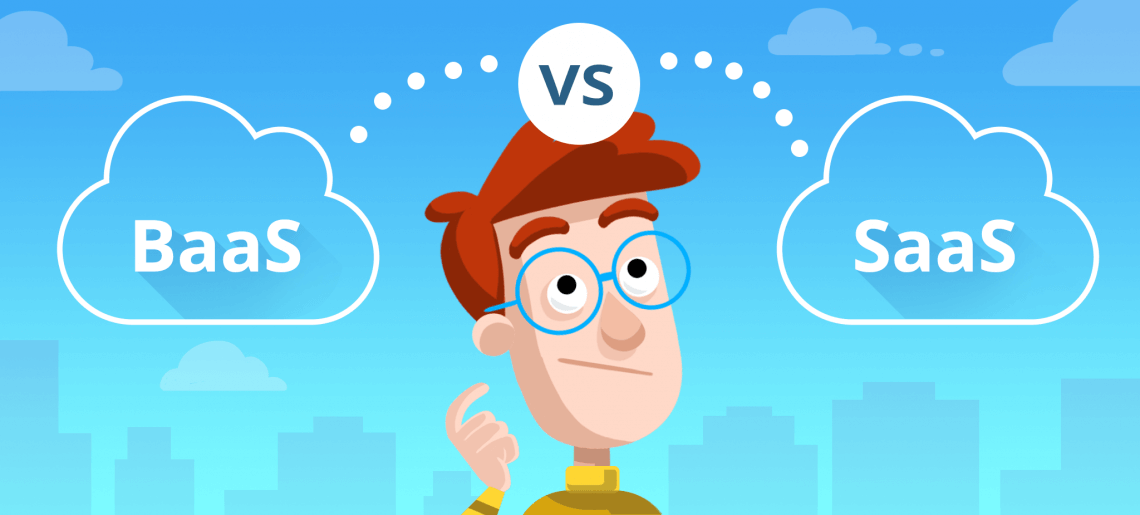
BaaS and SaaS sit at opposite ends of the cloud service spectrum. Backend as a Service (BaaS) gives developers a ready-made backend — database, authentication, APIs, and hosting — to build their own applications on. Software as a Service (SaaS) gives end users a finished application they simply log in to and use. One is a building block; the other is the completed building.
The confusion is understandable: both are cloud subscription services, and both remove infrastructure work. But they serve entirely different audiences and solve different problems. This guide breaks down how each model works, where they differ, and how to decide which one your project actually needs.
Contents
- 1 What is Backend as a Service (BaaS)?
- 2 What is Software as a Service (SaaS)?
- 3 BaaS vs SaaS: key differences at a glance
- 4 The differences in detail
- 5 One acronym, two meanings: Banking as a Service
- 6 How BaaS and SaaS work together
- 7 When to choose each model
- 8 Conclusion
- 9 What is the main difference between BaaS and SaaS?
- 10 Is Firebase a BaaS or a SaaS?
- 11 Can a SaaS product be built on top of a BaaS?
- 12 Does BaaS also stand for Banking as a Service?
What is Backend as a Service (BaaS)?
Backend as a Service is a cloud model that delivers everything an application needs server-side, without requiring you to build or operate it. Instead of provisioning servers, designing a database layer, writing authentication flows, and maintaining APIs, developers connect their frontend to a BaaS platform through SDKs and APIs, and the platform handles the rest.
Core features of a BaaS platform
- Managed database — relational or NoSQL data storage with automatic APIs (REST and GraphQL) generated on top of it.
- User authentication — sign-up, login, sessions, password recovery, and social login out of the box.
- Cloud functions — custom server-side logic that runs without managing servers.
- File storage — uploading and serving user files at scale.
- Push notifications and real-time data — live queries and messaging for interactive apps.
- Hosting, scaling, and security — the provider operates the infrastructure, backups, and patching.
Examples of BaaS platforms
Well-known BaaS providers include Back4app, Firebase, AWS Amplify, and Appwrite. Developers typically use them to ship mobile and web applications faster, since roughly the same backend features are rebuilt in almost every app.
What is Software as a Service (SaaS)?
Software as a Service is a delivery model where a complete application is hosted by a provider and accessed over the internet, usually through a browser. The user does not install, host, or maintain anything — they subscribe, log in, and work. All infrastructure, updates, and security are the provider’s responsibility, invisible to the customer.
SaaS is by far the largest cloud category because its audience is every business and consumer, not just developers. Salesforce, Google Workspace, Slack, Shopify, Zoom, and Notion are all SaaS: finished products that solve a business problem directly.
BaaS vs SaaS: key differences at a glance
| BaaS | SaaS | |
|---|---|---|
| Who it serves | Developers and product teams | End users and businesses |
| What you get | Backend infrastructure to build on | A finished, ready-to-use application |
| Technical skill required | Programming (frontend at minimum) | None — just use the software |
| Customization | High — you build the product yourself | Limited to the settings the vendor exposes |
| Typical pricing | Usage-based (requests, storage, compute) | Per seat or per subscription tier |
| Time to value | Days to weeks (you still build the app) | Minutes (sign up and start) |
| Examples | Back4app, Firebase, AWS Amplify | Salesforce, Slack, Shopify, Zoom |
The differences in detail
Audience: builders vs users
This is the cleanest way to separate the two. If the customer of the service writes code against it, it is BaaS. If the customer opens it and works in it, it is SaaS. A BaaS has SDKs, API keys, and documentation for developers; a SaaS has onboarding screens, dashboards, and support articles for end users.
Product vs building block
A SaaS subscription delivers outcomes directly — invoices sent, meetings hosted, tickets tracked. A BaaS subscription delivers capacity to create those outcomes: it becomes valuable only after your team builds an application on top of it. That also means BaaS carries development cost and time that SaaS does not, in exchange for owning a product that is exactly what you need.
Control and ownership
With SaaS you adapt your process to the vendor’s product. With BaaS you control the data model, business logic, and user experience — the platform only standardizes the plumbing underneath. Open-source-based BaaS platforms go further: because Back4app is built on Parse Server, an application can be migrated and self-hosted later, which limits vendor lock-in in a way closed SaaS products cannot match.
Pricing logic
SaaS pricing scales with people (seats, workspaces); BaaS pricing scales with usage (API requests, storage, compute time). A SaaS bill grows as your team grows. A BaaS bill grows as your application’s audience grows — which is why most BaaS platforms, including free BaaS tiers, let you start at zero cost and pay only when real traffic arrives.
One acronym, two meanings: Banking as a Service
A frequent source of confusion when researching this topic: in fintech, BaaS stands for Banking as a Service — licensed banks exposing accounts, cards, and payments through APIs for other companies to embed. That model has nothing to do with application backends. If you arrived here comparing cloud development platforms, Backend as a Service is the relevant meaning; both this article and our PaaS vs BaaS glossary entry use it exclusively.
How BaaS and SaaS work together
The two models are not competitors — they are frequently supplier and customer. A large share of modern SaaS products run on BaaS or similar managed backends: the SaaS company builds its differentiating features while the BaaS supplies databases, authentication, and APIs underneath. If you are planning a SaaS product of your own, a BaaS is one of the fastest routes to a production-grade backend, letting a small team reach market with infrastructure that would otherwise require dedicated backend engineers.
When to choose each model
Choose BaaS when…
- You are building a custom web or mobile application and want to skip backend boilerplate.
- No existing product fits your requirements closely enough.
- You need full control over data, logic, and user experience.
- Your team is frontend-strong but backend-light.
Choose SaaS when…
- An existing product already solves your problem well (CRM, email, project management).
- You need results today, not after a development cycle.
- You have no engineering resources and don’t want any.
- The problem is generic across companies rather than specific to yours.
Conclusion
BaaS and SaaS answer different questions. SaaS answers “can I buy software that solves this?” while BaaS answers “can I build my own software faster?” If you need a finished tool, subscribe to a SaaS. If you are creating an application — including the next SaaS — a Backend as a Service like Back4app gives you the entire server side on day one. For how BaaS compares to the rest of the cloud stack, see the IaaS vs PaaS vs BaaS vs FaaS glossary entry.
What is the main difference between BaaS and SaaS?
BaaS (Backend as a Service) provides developers with ready-made backend infrastructure such as databases, authentication, and APIs to build applications on top of. SaaS (Software as a Service) delivers complete, ready-to-use software to end users over the internet. In short: BaaS is a building block for creating software, while SaaS is the finished software itself.
Is Firebase a BaaS or a SaaS?
Firebase is a BaaS. It provides backend services like a real-time database, authentication, and hosting that developers use to build their own applications. The same applies to platforms such as Back4app and AWS Amplify.
Can a SaaS product be built on top of a BaaS?
Yes, and it is a very common pattern. Many SaaS companies build their products on a BaaS platform to avoid developing backend infrastructure from scratch. The BaaS handles data storage, user accounts, and APIs, while the SaaS company focuses on its user-facing product and business logic.
Does BaaS also stand for Banking as a Service?
Yes. In fintech, BaaS usually means Banking as a Service, where licensed banks expose regulated financial products through APIs. In software development and cloud computing, BaaS means Backend as a Service. This article covers the cloud computing meaning.