Cloud Computing has revolutionized business operations by providing efficient and cost-effective solutions for data storage, computing power, and software applications.
n India, the demand for cloud services has been steadily increasing. Consequently, it is prompting several providers to enter the market.
We will explore the top 10 Cloud Computing providers in India, analyzing their key features, services, and customer satisfaction.
Whether you are a small business owner or an enterprise-level organization, this guide will help you make an informed decision when choosing a cloud service provider.
Firebase has transformed web and mobile app development through its outstanding Backend as a Service solution.
This all-in-one Google-backed platform empowers dev teams to robustly create highly interactive web, Android and iOS applications.
With this BaaS solution, you don’t have to write the long script from scratch and govern obscure protocols.
Realtime Database, Cloud Firestore, push notifications, FCM, auto-scaling, auth, cloud functions, and Crashlytics are traits that give Firebase an edge over rivals.
Similarly, the free-tier package and user-friendly dashboard make this BaaS vendor perfect for startups and inexperienced developers.
However, most Google services are inaccessible in China; sadly, Firebase is one of them. Indeed, Firebase doesn’t operate in Mainland China.
So, if your app targets the Chinese market, you should consider using these Firebase alternatives.
Astro.js is a static site generator (SSG) and frontend framework for building fast, modern web applications.
It allows you to build fast and lightweight websites by pre-rendering static HTML, CSS, and JavaScript files at build time.
Unlike traditional SSGs, Astro.js also allows you to hydrate your static pages with JavaScript at runtime, giving you the flexibility to create dynamic and interactive websites.
This article provides a comprehensive tutorial on how to build an Astro.js application using Back4app as a Backend as a Service (BaaS).
It will provide an overview of Astro.js, its advantages and limitations, and a step-by-step guide on how to build and host an Astro.js application.
Since the release of ChatGPT, AI tools have garnered significant attention, leading many web developers to incorporate some level of AI into their workflow.
In this article, we’ll explain how using AI in web development could benefit you. On top of that, we’ll look at a practical example of using automating web development with AI technologies.
In our example, we will use the Back4app Agent — an AI-powered DevOps assistant, to build and deploy a web app to Back4app.
Although mobile applications seem straightforward to use, but there is a complicated backend behind a smooth interface. An app’s backend consists of server-side operations that end users couldn’t access. For the full decision framework, see how to choose a backend for your app.
It is arduous for developers to create, deploy, and maintain mobile app backends through conventional means.
However, MBaaS or BaaS platforms play a critical role in seamlessly developing, scaling, and managing server-side of mobile apps.
Indeed, MBaaS solutions are robust and economical for businesses, CTOs, dev teams, and product owners to build the backend of mobile apps.
So, this article will display one of the best mobile app backend services with their core traits.
Backends refer to server-side activities, imperative for the undisturbed and speedy development of applications.
Indeed, an efficient and compelling backend is vital for improved user experience, arranging and querying data smoothly and robust deployments.
Contrarily, feeble backends can lead to poor UX, server crashes, security problems and much more. Therefore, the use of good backends is necessary for developers, mainly if they are working on mobile frameworks like React Native.
Hereof, we present the top-notch backends for React Native apps to facilitate startups, dev teams and businesses with suitable options.
In recent years, cross-platform app development has gained significant popularity. It is mainly because of its ability to streamline the development process and reach a wider audience. However, having the right tools and frameworks can make a significant difference.
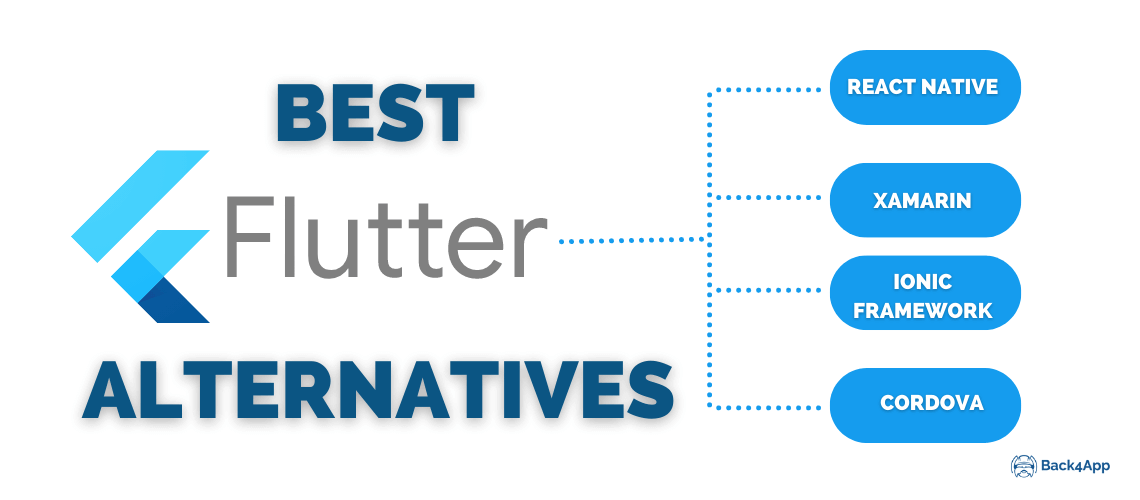
Flutter has emerged as a popular choice for cross-platform mobile app development. However, developers are always on the lookout for alternatives that can offer similar benefits and cater to their specific needs.
Therefore, it has become essential to explore other alternatives that can cater to specific project requirements.
Here in this article, we will delve into the top four alternatives to Flutter and analyze their strengths and weaknesses.
Kubernetes, often abbreviated as K8s, is an open-source platform designed to automate deploying, scaling, and operating application containers. It groups containers into pods, which are units of deployment on the platform. With Kubernetes, you can run any application, anywhere, making it a versatile tool for managing various tasks and workloads.
At its core, Kubernetes is about abstracting away the complexity of managing a fleet of containers. It provides a unified API to control how and where those containers will run, and a simple command line interface known as kubectl to manage cluster operations. The automation capabilities of Kubernetes can be especially crucial in a microservices architecture where you might have a variety of services, each running in a unique container.
While Kubernetes is powerful, it can be difficult to learn and use, and can be challenging to configure correctly. That’s where best practices come in. By following these guidelines, you can ensure that your use of Kubernetes is efficient, secure, and beneficial to your organization.
This figure was valued at 11.5 billion USD in 2021. This projection shows the growing influence of this app creation approach over dev teams and businesses.
So, this article presents one of the leading platforms to build low-code mobile applications with their key traits.