The Back4app Editorial Team brings together the backend engineers, cloud architects, and technical writers behind Back4app, the open-source-based backend platform. Every article is written or reviewed by practitioners who build and operate production backend infrastructure daily — covering Backend-as-a-Service, cloud deployment, APIs, databases, and mobile and web development. Tutorials are tested against real deployments before publishing, and guides are updated as platforms and pricing change. Our work is open for scrutiny: explore our code on GitHub, or see what developers say on G2 and Product Hunt.
This article will provide an in-depth analysis of Heroku, its significant advantages & disadvantages, pricing structure, and core features. It will also cover the differences between using Heroku vs. AWS and highlight the key Heroku alternatives.
Platform as a Service options help businesses create and manage high-performance applications. A reliable PaaS can help developers achieve streamlined API development and perform effortless database, IoT, communications, and process management.
Heroku is now regarded as one of the most reliable platforms as a service offering for businesses of all sizes. Look at this popular platform’s features, benefits, and limitations below.
In 2020, Heroku and Parse are two great platforms to speedup application development. Reading this article, you will understand the differences between these two platforms.
With the increase in the needs of developing the application and websites, it is becoming difficult for the people to manage the technical aspect of these applications alongside the maintenance of their content. It is owing to the reason that the need for continuous changes and the up-gradation of the data has increases.
This stress of development of the applications and the maintenance of all technical activities has become easier with the innovation of the clouding platforms, which develop and run the applications and provide more time to the users to work on creative side rather than the worry of maintaining the functioning of the technical work.
For the past few years, shoppers have changed their shopping behavior dramatically. Fortunately, businesses also have a lot in hand to catch and stay competitive in their industries.
However, over time eCommerce has become one of the leading trends for shoppers. Due to which the eCommerce industry has also been expanding vigorously over time.
Most importantly, within the next year, the revenues of eCommerce are expected to grow up to 5.4 trillion USD. On top of that, the emerging trend is also changing how retailers used to do their business before. Ecommerce businesses now can create smoother applications to offer a more seamless and convenient shopping experience to their customers. However, before simply starting to create an eCommerce app or site for your business, there is a lot to know in this regard.
So, here we have brought a detailed article for you regarding eCommerce and eCommerce benefits that you must know.
In January 2017 Facebook Parse hosting service was completely closed. We feel proud for the number of people that trusted in Back4App`s Parse hosting service. From the start of this journey, we learnt some lessons which we want to share with our community.
When launched, it provided exceptional NodeJS framework for the app building and scaling process. It was launched as an open source version of Parse.com. We took total control of the backend and avoided locks and limitations that occurred with Black Box solutions. Due to this, we were able to scale some apps up to 10.000 Req/s at the rate of about 80.000 simultaneous users.
The figures mentioned above show us that we were far better than many black box backends as Parse server was able to scale more than 600 Req/s that was told on the pricing page. There were numerous features that ensured that Parse server was the best app scaling option at that time.
Google has been investing a lot in improving Firebase during the last couple of years. It has the ability to provide a unified platform to build iOS, Android, and web applications. Authentication, AdMob, indexing, Analytics, notifications, VR/AR, and test lab are some of the new features that have been introduced in this Firebase’s latest versions.
While, on the other hand, Parse Server can be a better choice to build new APIs and applications. It’s an excellent option for developers looking for an open-source backend with a relational data structure.
If you want to know more about both Parse server and Firebase, then keep on reading the following information to get a compelling sense of comparison between them.
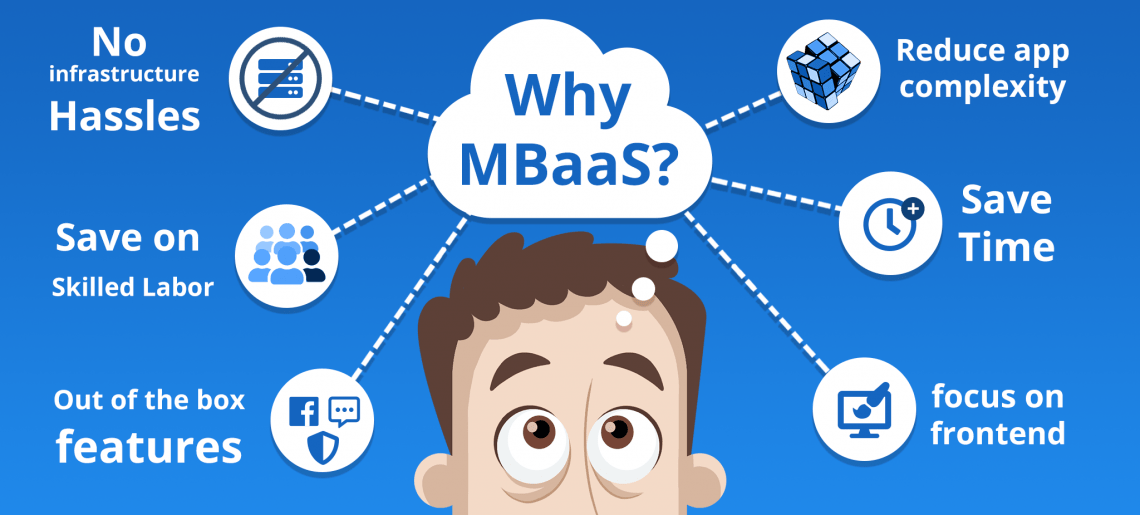
We are living in the era of digital technology. New mobile applications are arriving with every new day to bring new experiences to users. In the application development industry trend of MBaaS is emerging. This approach is meant to help developers in managing backend services of their application in a more effective and efficient way. However, with the growth of mobile devices, and mobile applications, a number of MBaaS platforms are also stepping into this market. However, going with the option which has the ability to meet the requirements of managing, developing and deploying your application cycle is always important. And, Kinvey can be one of the best picks to consider in this regard. Because this comes up with its unique features and advantages which you can’t avoid.
For most of the front-end developers out there MBaaS (Mobile Backend as a Service) looks like a startup application nirvana. This can help them replace their complete backend infrastructure with an API driven, cloud-based service which they can drive and direct with ease. Even more, Mobile Backend as a Service has also become one of the largest trends in mobile development market of the present day. While, various ambitious developers are lacking the ability to manage AWS instances. So, entering MBaaS market with an option which can bring a newest flavor to your application development process. Backendless is an amazing option which you can consider in this regard. Because this is a MBaaS solution which has a lot to offer you.
This article will discuss the best open-source backend frameworks. It will provide an overview of each platform, the core features, and its advantages.
There are tons of open-source backend frameworks available online, but not all of them offer great features and benefits. Some open-source backend frameworks offer limited features to developers.
Some of them are not even commonly used, while others are available for a limited time duration. In such kinds of scenarios, developers have to face a lot of problems. They don’t get their solutions this way and have to suffer a lot because of this issue.
So, here we are going to tell you about some of the best open-source backend frameworks in the market that you can use to make your development efficient.
Do you operate a business looking to develop an e-commerce platform similar to Amazon? If you are, the following article should be of immense help to you.
How do you start building an app like Amazon?
The trend of online shopping is enhancing at a fast pace in the last few years. Statista presents that the sales of retail e-commerce were around 4.28 trillion USD in 2020.
These retail e-commerce sales were only 1.3 trillion USD in 2014. Withal, the online shopping trends are increasing day by day. Statista also forecasts that e-commerce sales would reach 6.3 trillion USD in 2024.
However, if we talk about the most popular e-commerce shopping platforms, Amazon is at the top. Yes, a worldwide survey of Statista claims that 52% of online shoppers utilize Amazon for online shopping.
So, after knowing these appealing stats of Amazon, do you also want to build an app like Amazon to conduct shopping ventures for your business? If yes, then have a look at our guide.
Although developing an app like Amazon could be a tricky process, but following steps would definitely assist you in this regard. Here are 10 steps you need to follow to make an app like Amazon:
What you will learn from this article?
An overview of Amazon and its services
Ten steps to create an effective Amazon clone app
Essential features for creating retail eCommerce platforms
Have you heard about Uber? It is one of the most outstanding app success stories we have around today. But this article is not about Uber, it is about you. How about you creating the next multi-billion-dollar taxi app? Don’t be scared, it is possible, and we will show you how to go about creating an app like Uber.
How to make an app like Uber?
This article is a practical guide on how to create an app like Uber. It summarizes our experience of over 10 years in application development. If you follow this guide carefully, you can save lots of money and headache while developing an app like Uber.
Uber is one of the pioneers of taxi booking apps. The success of Uber inspired many other businesses to create similar apps. However, Uber remains the leader in that sector. The app was able to stay on top because of the simplicity and the convenience that users enjoy. This guide outlines how you can make an app like Uber. It also points out how other digital service providers in the sharing economy can elevate their business by taking a cue from Uber.
Below are the key points to know when developing an app like Uber:
Creating an MVP is the first step.
Don’t rush into coding.
Create a functional prototype first.
Essential strategies for app development
Technology stacks and other intricacies of app development.
The Admin backend and user frontend features of an app like Uber.